Advanced method for analysing urban development
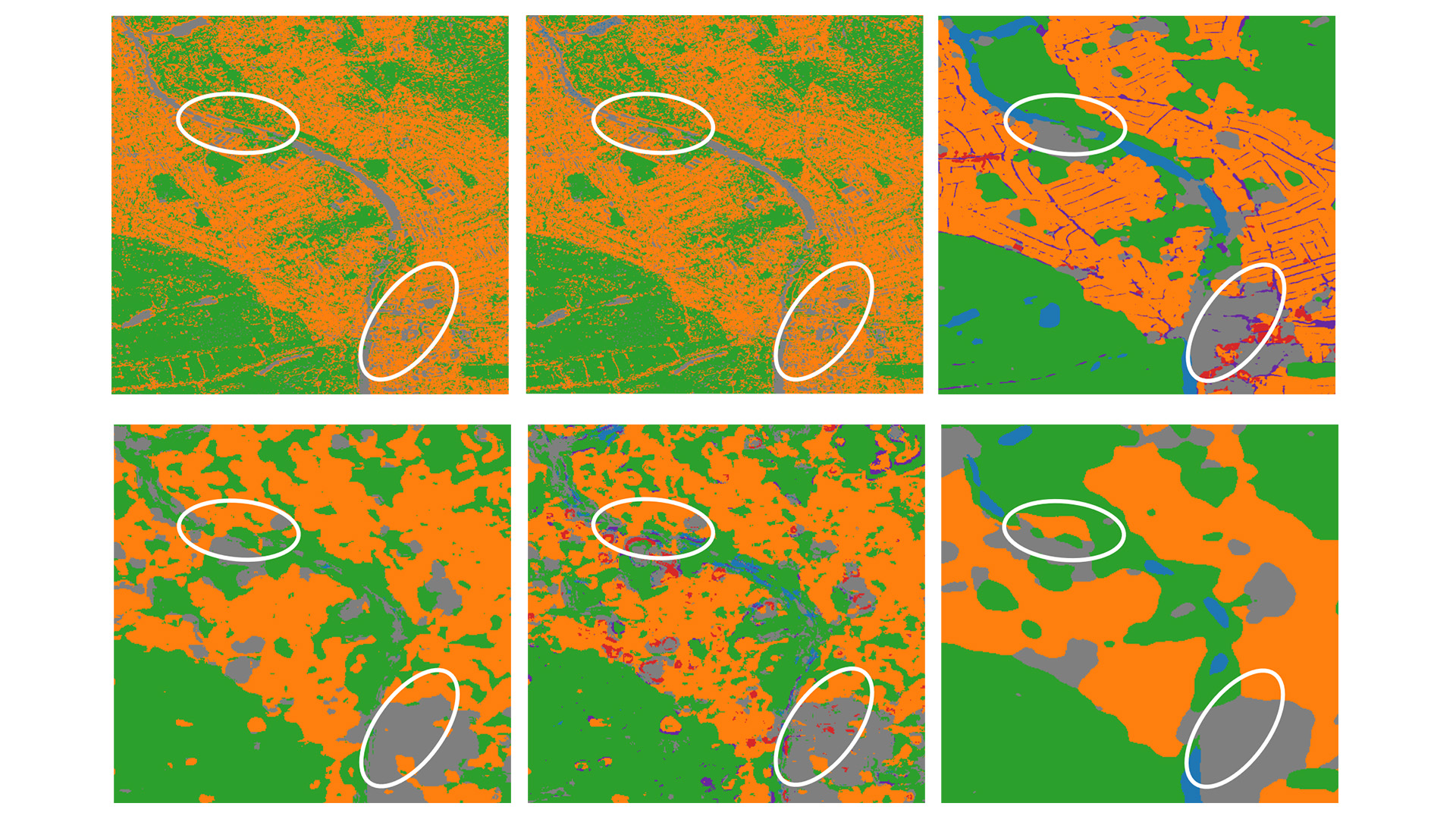
Visual comparison of algorithms using an optimal combination of features.
A team of scientists from the Warsaw University of Technology has developed an innovative method of automatic classification of urban development density with the use of microwave SAR satellite images (Synthetic Aperture Radar). Joanna Pluto-Kossakowska, PhD, from the Faculty of Geodesy and Cartography, in collaboration with Sandhim Wangiyana from the Faculty of Electronics and Information Technology, has developed a methodology that can support the monitoring and planning of urban fabric.
The research was conducted as part of the Virtual Laboratory of Modelling Geoinformation for Cities (VCityLab), operating at the WUT Faculty of Geodesy and Cartography and focusing on advanced geoinformatics methods in the analysis of urban structures.
“The main objective of the project was to develop the methodology for differentiation of various types of urban development, to begin with densely built-up areas and to end with industrial zones and greenery,” says Joanna Pluto-Kossakowska, PhD. “The research was conducted in two European metropolises: London and Warsaw – a selection based on the diversity of urban and topographic structures. SAR satellite systems operate independently of weather and lighting conditions, which gives them a significant advantage over traditional optical images. The analysis incorporated data from two types of microwave sensors: high-resolution ICEYE operating at the X-band and generally accessible Sentinel-1 operating at the C-band. Advanced technologies of image processing were employed, including texture analysis and machine learning algorithms. Texture features and extracting information on the physical character of the building were crucial.

Research areas: London (left) and Warsaw (right). The visualisation depicts Sentinel-1 (Copernicus) imagery with an ortophotomap (Bing) in the background.
The research compared different machine learning algorithms, including Random Forest and Extreme Gradient Boosting, among others, and the U-Net neural network based on a convolutional architecture. The study examined how differences in spatial resolution and SAR data polarisation impact the ability to discriminate between urban classes, including the detection of small objects such as roads and buildings. The U-Net network accomplished the best results, attaining a general precision of 79% for high-resolution data from the X-band. Data from the ICEYE satellite with a 0.5-metre resolution allowed for better identification of classes with a complex development structure. Research also showed that algorithms based on neural networks fare better with challenges related to the noise typical for radar imagery.
“The innovativeness of the research involves a complex approach to the analysis of SAR data in the context of urban planning and the creation of a new set of reference data based on the Urban Atlas database,” explains Joanna Pluto-Kossakowska, PhD. “The results hold substantial practical value for monitoring urban change dynamics and supporting spatial planning processes. The developed methodology can be used by local governments and institutions involved in urban planning to regularly monitor city development, which is particularly valuable in the context of sustainable development.”
The research emphasises the value of SAR data as a complementary source of information on the structure of cities, especially if optical images are not available due to an overcast sky. Research findings were published in the article “Supervised Semantic Segmentation of Urban Area Using SAR” and significantly contribute to the development of tele-detective technologies used in urban planning. The paper proves that the combination of advanced methods of machine learning with radar data provides new opportunities for monitoring the urban environment. More information about the VCityLab team at: www.vcitylab.pw.edu.pl.