Combining advanced technologies and environmental care
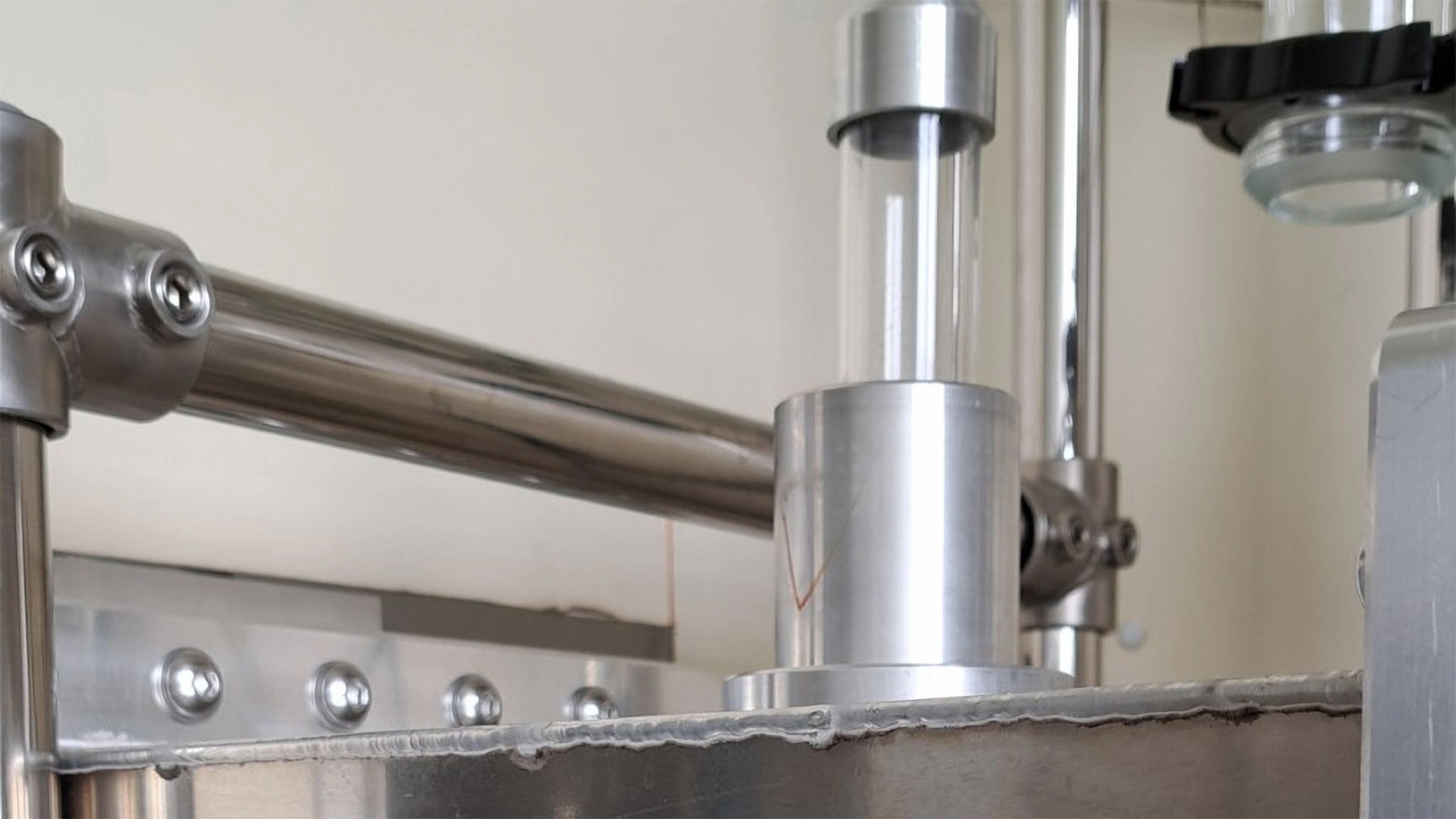
A part of the installation used in the TITAN project.
In the era of growing environmental challenges and the need for energetic transformation, scientists at the Warsaw University of Technology are taking part in one of the most innovative research projects in Europe – TITAN (Direct biogas conversion to green H₂ and carbon-based materials for soil enhancement and SiC production using a scalable microwave catalytic reactor). The initiative aims to develop a technology that facilitates direct biogas conversion to green H₂ and precious carbon-based materials in a new generation catalytic reactor.
The TITAN project is implemented as part of the Horizon Europe programme (HORIZON-CL5-2021-D2-01), funded by the European Commission in the area of Climate, Energy and Mobility. A team from the Faculty of Chemical and Process Engineering at WUT, led by Professor Robert Cherbański, is a project partner and is responsible for Work Package 2 (WP2), which mainly includes the design of catalysts, thermodynamic calculations, research on the kinetics of chemical reactions, and the development of a mathematical model of a reactor.
The technology under development aims to convert the energy of microwave radiation into heat directly in the catalyst bed, significantly enhancing the energetic efficiency of the process. Two processes of obtaining green hydrogen are being investigated: methane pyrolysis and dry methane reforming, both carried out on catalyst grains maintained in a fluidised state. Neither of the processes generates CO2 emissions into the atmosphere, and both yield carbon materials with potential applications in soil fertilisation and silicon carbide production, among others. These applications are also being researched as part of the ongoing project.
As part of WP2, numerous catalysts were tested, including the most promising Fe/C, achieving 95% methane conversion in the researched process. Research is also being conducted on modifications to catalysts that can support the growth of carbon nanotubes and on methods for their regeneration.
Research done by WUT scientists also includes kinetic and hydrodynamic modelling, research into catalyst regeneration and reactor operation simulation, which provide the foundations for scaling the process to Technological Readiness Level 5 (TRL 5, technological demonstrator). The research findings obtained so far have been published in “Chemical Engineering and Processing – Process Intensification”, a scientific journal devoted to the intensification of processes, among others.
TITAN is not only a technological project but also a pro-ecological initiative fitting into the European strategy of climate neutrality. Biochar produced during the process may be used to fertilise soil near local biogas plants, facilitating long-term carbon storage in the soil and reducing greenhouse gas emissions. Research conducted as part of the project also includes a toxicological assessment of biochar, its impact on soil organisms, and its ability to improve water retention and soil quality.
An interesting element of the project is the use of artificial intelligence for the analysis of the process of catalyst deactivation. The WUT research team has developed a mathematical model based on artificial neural networks, enabling us to predict changes to the catalyst activity during its operation. This model is used in the study of catalyst coking, which leads to their deactivation.
One of the tangible project outcomes is a measurement station constructed and launched at the Faculty of Chemical and Process Engineering at WUT, dedicated to research on hydrogen production in a microwave-heated fluidised bed reactor.
The TITAN project fits perfectly into the objectives of European green energy transformation. The technology under development not only allows for the production of green hydrogen and carbon materials but also contributes to negative CO₂ emissions and the development of a closed-loop economy.
As a consortium partner, the Warsaw University of Technology is a key contributor to this groundbreaking technology, combining chemical engineering, modern catalysis, and microwave techniques.
The project will continue until August 2026, and its outcomes may contribute to the development of future hydrogen technologies in Europe.