Innovative projects by Piotr Falkowski, PhD
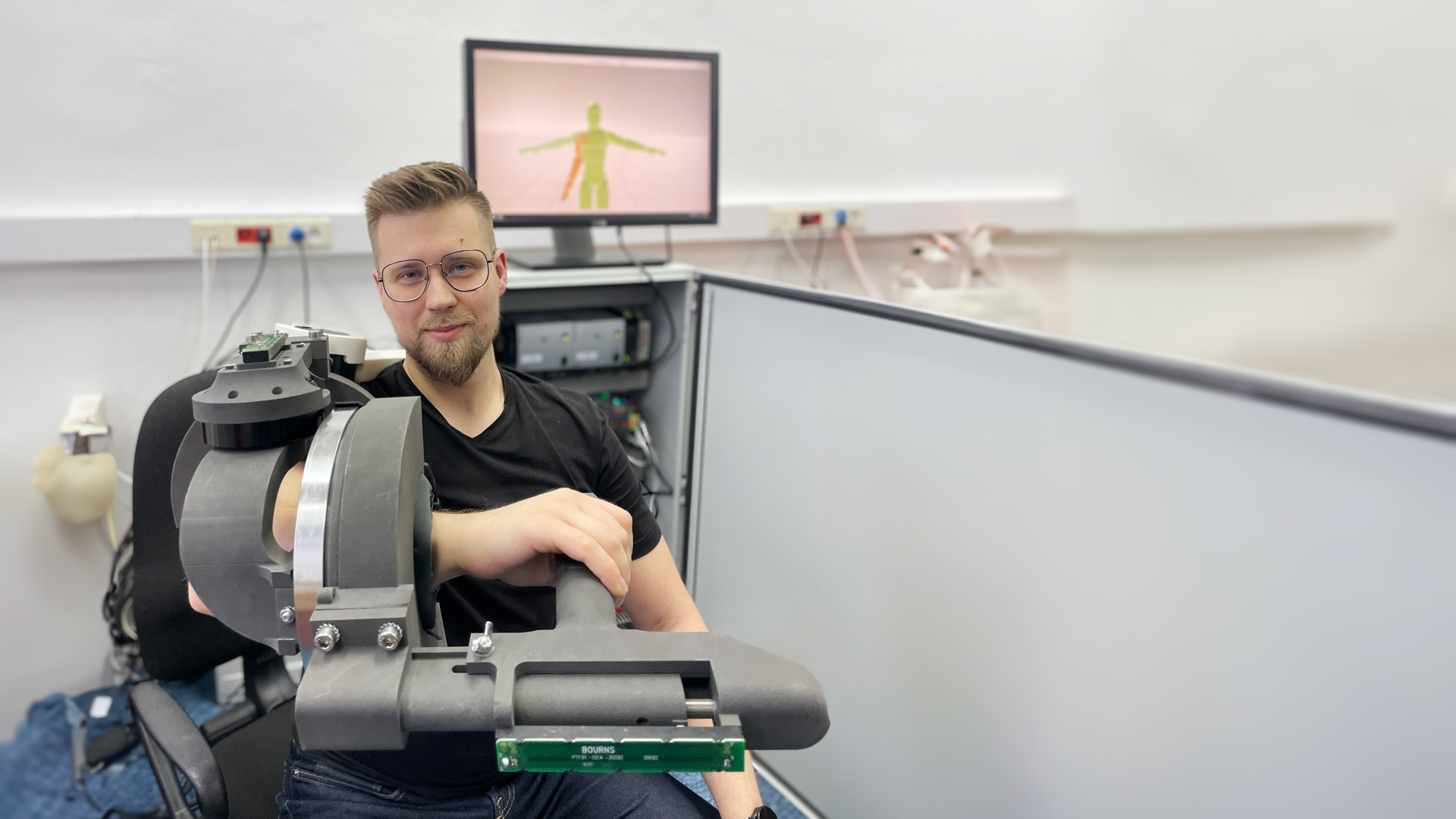
Innovative projects by Dr Piotr Falkowski
Our graduate, Piotr Falkowski, PhD, is developing two projects aimed at facilitating remote rehabilitation for patients. The initial idea for creating rehabilitation robots grew out of his industrial PhD carried out at the Warsaw University of Technology in cooperation with the Łukasiewicz Industrial Research Institute for Automation and Measurements. Recently, both tools have received awards and have been presented at international exhibitions.
The author of the SmartEx‑Home and SmartEx‑Twin projects, Dr Falkowski, works in the fields of biorobotics and 3D printing. He is a graduate of the Faculty of Power and Aeronautical Engineering at the Warsaw University of Technology, and after completing his studies he continued his academic path through an industrial PhD carried out at the Warsaw University of Technology and the Łukasiewicz Research Network – Industrial Research Institute for Automation and Measurements PIAP. It was during his doctoral studies that he developed the concepts for a universal and lightweight structure and a control method for an exoskeleton designed for remote, home‑based functional rehabilitation (SmartEx‑Home), as well as an intelligent exoskeleton for remote rehabilitation using digital twin technology (SmartEx‑Twin).
Work on the projects did not end with his PhD defence. Piotr and his team at Łukasiewicz‑PIAP, which partly consists of students and graduates of the Warsaw University of Technology, continue to develop the projects successfully. The project team has from the beginning included employees of Łukasiewicz‑PIAP: Piotr Falkowski (project lead, bioroboticist, WUT graduate), Piotr Kołodziejski (mechanical engineer, former WUT student), Krzysztof Zawalski (automation and electronics specialist, WUT student), Jan Oleksiuk (programmer, WUT student), Kajetan Jeznach (programmer, WUT graduate), Maciej Pikuliński (automation specialist, WUT doctoral candidate), Andrzej Zakręcki (mechanical engineer, AGH University employee), Tomasz Osiak (physiotherapist, University of Physical Education graduate) and Daniel Śliż (medical doctor, Medical University of Warsaw employee).
In recent months, the team has received, among other distinctions, a special award in the Student‑Inventor competition. The prize for the winners was participation in the innovation exhibition in Geneva, where the projects achieved further success. The creators of both tools were awarded a gold medal there. The team also presented both projects at other international exhibitions.
“The exhibition in Geneva and the visit to the World Intellectual Property Organization helped us reach a wider audience interested in new technologies and talk to experts in the field of transferring research results to business and protecting intellectual property. This year, our inventions were also presented at the IWIS exhibition in Warsaw, as well as in Nuremberg, Zagreb and Macau,” says Piotr Falkowski, project lead for SmartEx‑Home and SmartEx‑Twin.
Innovative projects supporting physiotherapists and patients
The SmartEx‑Home project, carried out under the NCBR LIDER XIV programme, responds to the need for greater availability of devices for robotic remote rehabilitation with automatic control that assists the movements of the user‑patient and ensures that exercises are performed within the correct range of motion. An important factor is also maintaining patient safety in home conditions.
The technical and scientific work includes three main stages: modelling and studying the dynamics of functional training, mechanical optimisation and adapting the prototype for research on control algorithms, and research on optimal exoskeleton control. The project will run until July 2026, and its outcome is expected to be a prototype ready for implementation and for further development of rehabilitation‑related technologies. The creators obtained funding of 1,793,900 PLN from the National Centre for Research and Development (NCBR) for this project.

Innovative projects by Piotr Falkowski, PhD (photo: Łukasiewicz PIAP)
The second project, SmartEx‑Twin, was carried out in 2023–2025. As part of the project, a lightweight and portable rehabilitation device for the lower limb was developed and built as a demonstrator of the technology. It is intended for people after strokes or with orthopaedic conditions. Its operating conditions allow it to be used at home, and the use of VR technology and a digital twin enables physiotherapists to plan and monitor exercises remotely. The demonstrator has undergone functional testing in laboratory conditions and is being presented to potential users and interested medical‑device manufacturers.
The main goal of the project was to conduct research on improving the quality, effectiveness and accessibility of motor‑rehabilitation exercises using supportive mechatronic and robotic devices equipped with the latest ICT solutions, as well as to implement telerehabilitation based on a digital twin and VR technology.
“The research projects are now being continued with the aim of bringing the technology to market. This year, we are preparing the final prototype of the upper‑limb exoskeleton and the documentation required for its certification as a medical device. We plan this for 2027. As for the lower‑limb exoskeleton, we intend to continue its development within further R&D projects so that we can create a system on a mobile platform that automatically supports both limbs. This will allow neurological and orthopaedic patients to independently practise everyday activities while moving,” added Dr Falkowski.
The project partners were: Elmiko Biosignals Sp. z o.o. (Poland), Bartin University (Turkey) and 3LS R&D Consulting Industry and Trade Inc. (Turkey). The project was funded by NCBR under the fifth edition of the Polish–Turkish Cooperation programme. The total funding amounted to 250,721.14 EUR, including 155,101.56 EUR from Łukasiewicz‑PIAP.