WUT neutrino researchers co author a publication in Nature
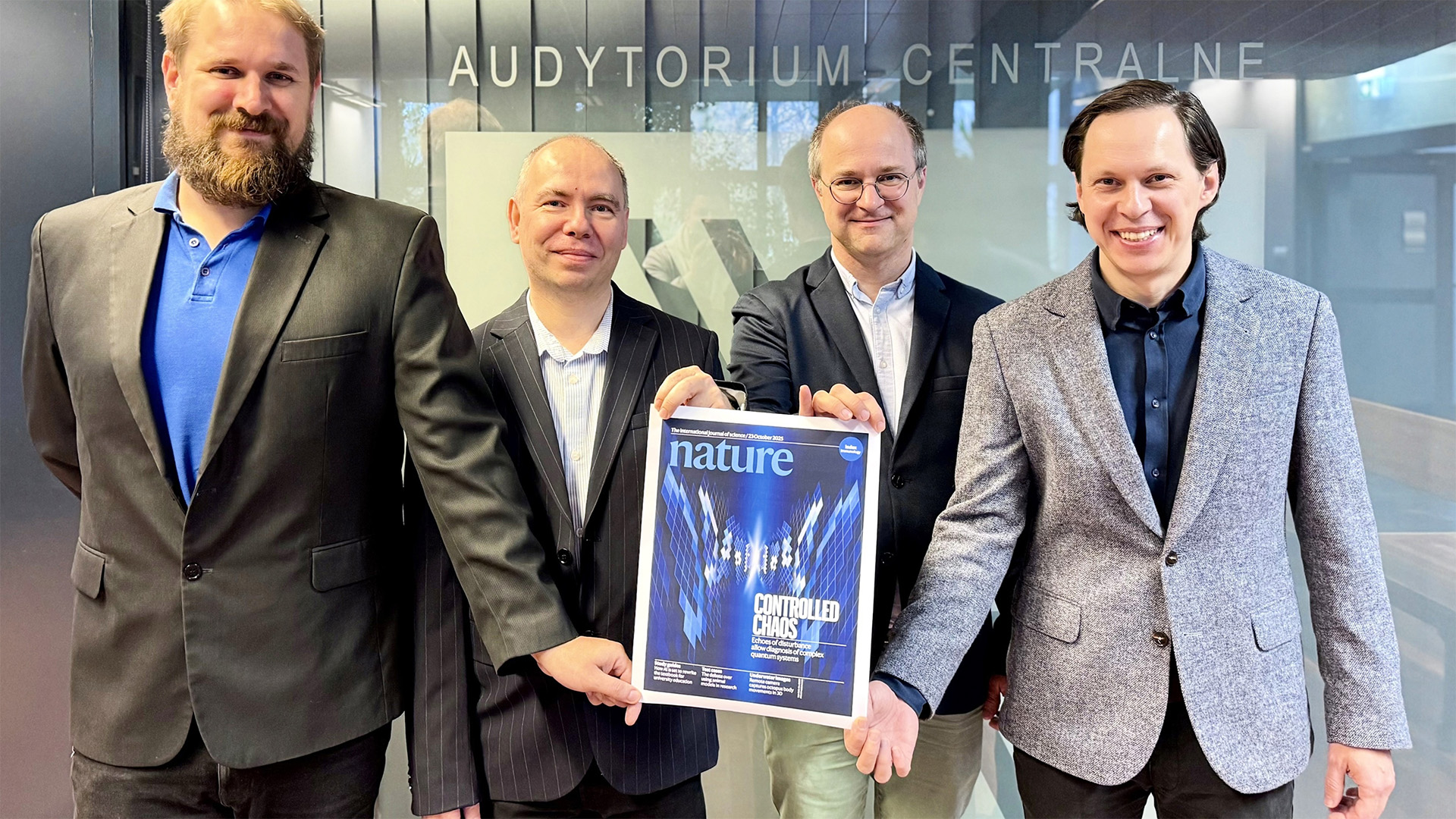
Co‑authors of the Nature publication. From left: Krzysztof Dygnarowicz, Robert Kurjata, Marcin Ziembicki and Andrzej Rychter
Researchers from the Institute of Radioelectronics and Multimedia Technology at the Faculty of Electronics and Information Technology are involved in the T2K experiment in Japan. A joint analysis of neutrino‑oscillation data from the T2K experiment and the NOvA experiment in the United States has been published in the prestigious journal Nature. The publication was co‑authored by Dr Robert Kurjata, Dr Andrzej Rychter, Dr Marcin Ziembicki and Krzysztof Dygnarowicz, Msc.
Two international teams of scientists working on two neutrino experiments have undertaken the effort to prepare the first joint data analysis. The work has yielded some of the most precise measurements of neutrino oscillations to date. The T2K and NOvA experiments are long‑baseline experiments that study neutrino oscillations using accelerator‑generated beams. By combining different baseline lengths (the distance between the point where the neutrino beam is produced and the point where it is detected) and different neutrino‑energy ranges, they achieved highly precise measurements of this phenomenon.
They succeeded in reducing the uncertainty in measuring the differences between neutrino masses to below 2%. Although the hierarchy of the three neutrino masses remains unknown, the results indicate that the degree of CP symmetry violation (the difference in behaviour between particles and antiparticles) may be strongly constrained. This achievement marks an important step toward discovering CP violation in the neutrino sector and explaining the matter–antimatter asymmetry in the present‑day universe.
The joint analysis combined T2K data collected over ten years since 2010 with NOvA data gathered over six years since 2014. Conducting such an analysis demonstrates the value and strength of collaboration between two international experiments that both compete with and complement each other.
The results of the first joint analysis do not yet fully reveal the mysteries of neutrinos, but they significantly expand physicists’ understanding of these particles. They also confirm the value of the impressive collaborative effort undertaken by the two competing yet complementary experiments.
The Polish Neutrino Group has been involved in the T2K experiment since 2007 and brings together six institutions: the National Centre for Nuclear Research, the University of Warsaw, the Warsaw University of Technology, the University of Silesia, the University of Wrocław and the Institute of Nuclear Physics of the Polish Academy of Sciences. Polish physicists and engineers helped build the near detector and, once the experiment began operating in 2010, took part in data collection, simulations, calibration, data‑quality checks and analysis. Their contribution is underscored by the important positions Polish researchers hold within the T2K collaboration, including co‑chairing working groups and serving on the Executive Board, Analysis Steering Group and Publication Board.