
Design and testing of advanced rocket structures
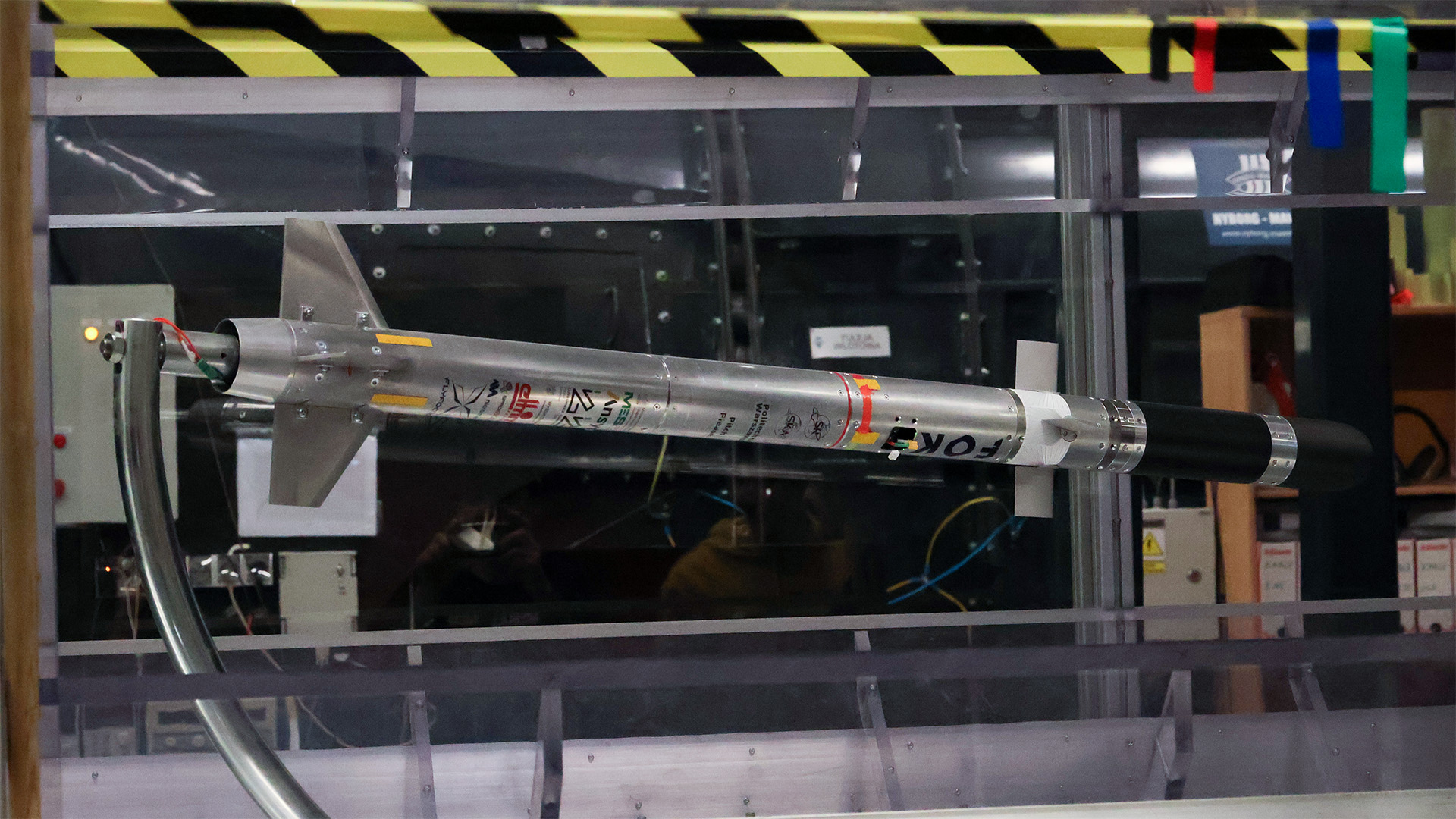
The FOK 2 rocket
Students working in the Rocket Section design and test rocket systems and propulsion technologies. The team is currently focusing on preparing publications, including for the PAC 2026 conference, as well as on preparations for the FAR–OUT competition in the United States.
The students’ work includes the FOK 2 rocket with its control system, the Twardowsky 2 rocket with hybrid propulsion, and the Grot 2 rocket programme, which focuses on multi‑stage rocket systems. They also conduct research in the areas of aerodynamics, sensors and the development of test stands related to rocket technologies.
The Rocket Section has an impressive track record, including the construction of the Amelia and A2 rockets, the supersonic TuCAN rocket, and the Polish altitude record for an amateur rocket, set in 2019.
Wind‑tunnel tests of the rocket
The students are carrying out these tests in connection with the submission of a paper for the PAC 2026 conference. The analysis focuses on the influence of canard geometry – the forward control surfaces – on the rocket’s flight characteristics, stability and controllability. Measurements of the forces acting on the model at varying speeds and angles of attack make it possible to determine the aerodynamic coefficients required for designing the flight‑stabilisation system. The wind‑tunnel tests are used to collect data and reproduce real loads prior to the launch phase.
Strain gauges printed on fabric
In parallel, in collaboration with the Organza student research group, studies are being carried out on strain sensors for parachute canopies. The project uses strain gauges printed directly onto the fabric, characterised by low weight and flexibility. They record stresses during deployment, descent and manoeuvres. Simulating such loads in laboratory conditions poses an engineering challenge. In‑flight measurements provide precise data on the distribution of forces across canopy segments and on locations where overloads occur. These results support design optimisation and improve the reliability of recovery systems. Directly printed strain gauges eliminate additional mass and stiffness, minimising measurement errors.

Preparations for rocket engine tests
Hardware‑in‑the‑Loop (HIL) test stand
The team working on the Twardowsky 2 rocket is carrying out the preparation phase for the FAR–OUT competition in California. A qualification requirement is a hot‑fire test, involving firing the engine on a static test stand. The procedure verifies the fuelling sequence, the stability of thrust and pressure parameters, and the tightness of the system. The test was conducted in April: the Aurora hybrid engine operated for 7 seconds, generating a maximum thrust of 8.3 kN. The regulated pressurisation system used in the setup, with an independent nitrogen tank and a pressure regulator, ensures a constant oxidiser pressure, stabilising the thrust curve.
The rocket’s structure has been upgraded following last year’s EuRoC competition. The avionics module has been redesigned, introducing a modular architecture with a central main board and attachable mission‑specific modules. A new mechanism for releasing the main parachute has been implemented. Structural modifications have reduced the mass and improved access to the hydraulic systems. An inter‑module radax interface has also been introduced, enhancing the stiffness of the connections.

Aurora hybrid engine tests for the Twardowsky 2 rocket
The SKA Rocketry team representing Warsaw University of Technology consists of: Szymon Krupa – Twardowsky 2 project coordinator, Eliza Łapińska – deputy project coordinator, Michał Kret – systems engineer, Przemysław Orzeł – mechanics team lead, Remigiusz Michna – propulsion team lead, Patryk Kasperski – ground support equipment (GSE) team lead, Maciej Kaczkan – electronics team lead, Radosław Kamiński – analysis team lead, and Aleksandra Skrocka – promotion team lead.
The work is supported by technical specialists: Katarzyna Puziuk, Malwina Bielecka, Karol Borecki, Juliusz Pytka, Maurycy Matałkowski, Miłosz Łosiewicz and Piotr Łyżwa.
Development directions
The activities of the Rocket Section of the Student Astronautical Association are characterised by the parallel execution of research and engineering processes. These include analytical studies requiring experiment planning, as well as structural tests that determine the feasibility of launch operations. The PAC 2026 conference will enable direct knowledge transfer to the scientific community. Participation in the FAR–OUT competition, in turn, will provide a practical verification of the developed technologies in an international competitive setting.
© 1998-2026 Warsaw University of Technology
Pl. Politechniki 1, 00-661 Warsaw, Poland