
Development of unmanned systems and kinetic technologies
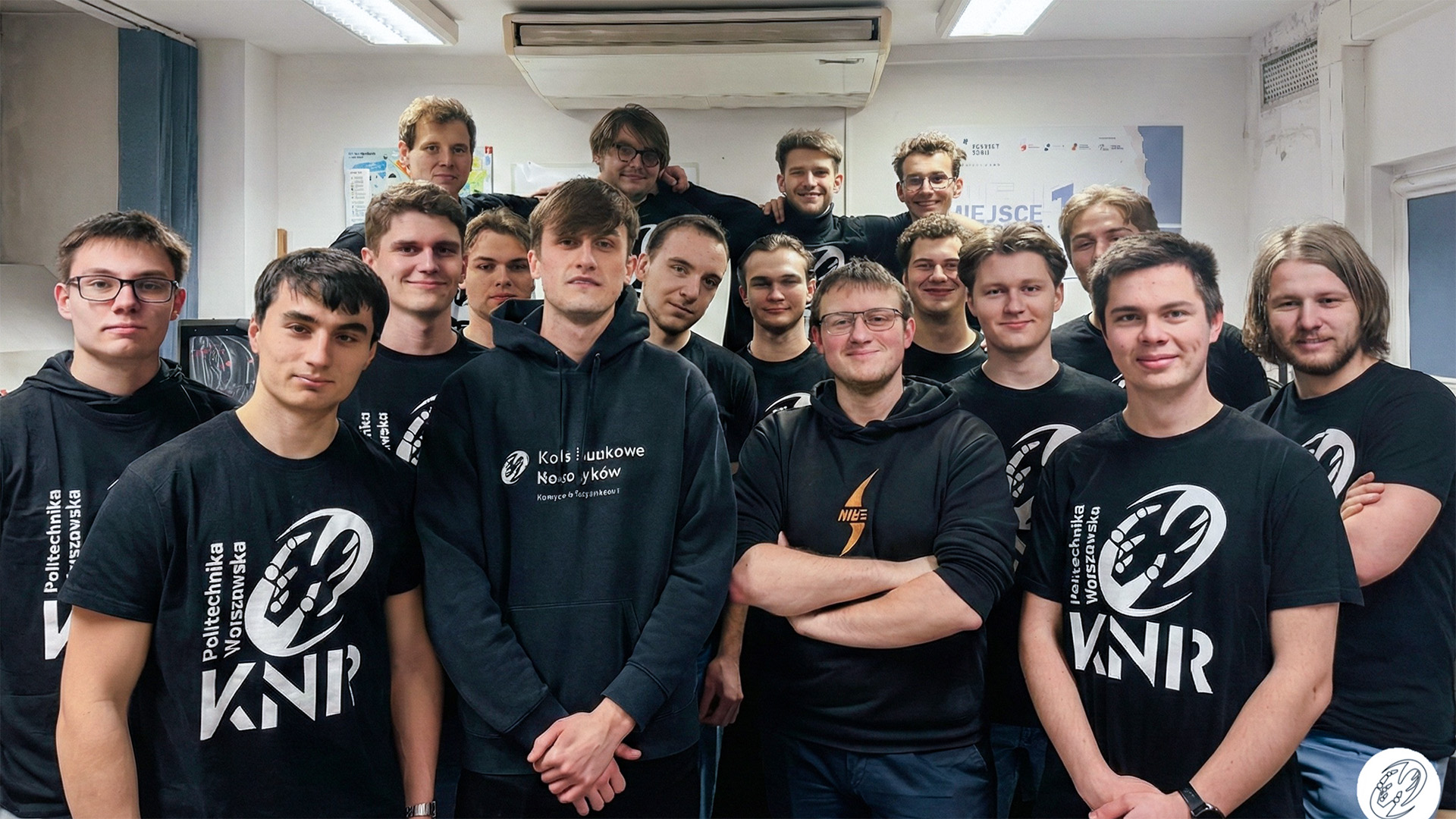
Robotics Student Research Group – the Drone Section
The Drone Section operating within the Robotics Student Research Group at the Faculty of Power and Aeronautical Engineering of Warsaw University of Technology has been active since 2023 and has quickly built a strong interdisciplinary team of around 30 members.
Although formally affiliated with the Faculty of Power and Aeronautical Engineering, its members also represent other units of Warsaw University of Technology, in particular the Faculty of Electrical Engineering and the Faculty of Electronics and Information Technology, which enables the integration of competencies in mechanics, electronics and computer science. The section’s current main areas of activity include the development of VTOL platforms, autonomous flight control systems, visual data processing and the integration of advanced onboard systems.
Key achievements and completed projects
Since the beginning of its activity, the team has consistently carried out research and development projects and has actively participated in industry events and technology competitions. Among its most notable achievements are 4th place in the relay competition at Droniada 2024 and a distinction for the best software system in the 2025 edition. The Section also won 1st place in the “Ecology” category in the KOKOS competition, and its representatives presented their solutions at the 34th International Defence Industry Exhibition. Successes have also been achieved individually, with three team members winning the StartupHACK hackathon. The development of the projects is supported, among others, by the “Student Research Groups Create Innovation” programme and the ORLEN Foundation’s TURBOgrant.
VTOL and preparations for SUAS
In its work to date, the section has developed three complete unmanned aerial vehicle designs, which serve as the basis for further project iterations. The fourth and most advanced system currently under development is the STORK 1 tilt‑rotor VTOL platform. Conceptual work on this design began in May 2025. The drone combines vertical take‑off and landing capability with the flight efficiency characteristic of fixed‑wing aircraft, making it a solution with significant potential. The project integrates numerous engineering areas, including aerodynamics, material strength, vibration analysis, as well as vision systems and artificial intelligence algorithms. The onboard equipment includes advanced components such as LiDAR, an RTK GPS system, an NVIDIA Jetson computer and a set of photogrammetric cameras.
One of the key engineering challenges concerns vibrations and the stability of the transition between multirotor mode and horizontal flight. The team is currently focusing on optimising structural stiffness, reducing vibrations and refining the aerodynamic characteristics. In parallel, preparations are underway for the international SUAS competition in the United States, where the platform’s autonomous capabilities are of crucial importance. As part of the competition, the drone must perform missions that include flying through designated waypoints, generating a high‑resolution orthophotomap of the area, and autonomously detecting and precisely delivering payloads. All tasks must be completed within a limited time and at a considerable altitude, which requires high reliability of the control and data‑processing systems.

One of the Drone Section’s designs
Preparing for the Droniada competition
Another important area of work involves preparations for the Droniada competition, particularly for the Hydrolab and Last Mile Logistics challenges. In this field, the team is developing its original “Mamba” platform, which is being adapted both mechanically and electronically to meet the specific requirements of the competition tasks. A key element of the project is a module for autonomous water sampling. The system under development is based on a self‑sealing tank that uses buoyancy forces for filling and a sealing mechanism during resurfacing. The entire setup works in conjunction with a winch system and enables measurements of environmental parameters such as pH, temperature and electrical conductivity. In parallel, target‑detection algorithms and control systems are being developed, as well as the project’s IT infrastructure, including a dedicated website.
Kinetic drone‑neutralisation system
The third area of research is the development of a kinetic drone‑neutralisation system carried out under the “Student Research Groups Create Innovation” (KNTI 6.0) programme. The project aims to create an integrated anti‑drone solution in which a supervisory unit identifies a target using acoustic, thermal and vision sensors, and then directs an interceptor drone towards it. Using the transmitted data, the interceptor locates the target and neutralises it with a net, after which both objects descend safely on a parachute. This system addresses the growing demand for technologies that protect critical infrastructure. The proposed solution is currently being analysed in terms of the defined design assumptions.

One of the Drone Section’s designs
Potential applications
The solutions developed within the section have a wide range of potential applications. The VTOL platform may be used for industrial infrastructure inspections, airspace monitoring or medical transport requiring rapid response. The systems created for the Droniada competition can be adapted for environmental monitoring, including the assessment of water, soil or air quality. Meanwhile, the anti‑drone technologies developed under the KNTI programme address the needs of the security sector.
Project team
The SUAS 2026 project involves the largest number of members of the group. The software section includes Rafał Lesiak (coordinator), Piotr Pawlus, Paweł Kwiatkowski, Michał Lejwoda and Mateusz Stelmasiak. The electronics section consists of Krystian Wiśniewski (coordinator), Paweł Zawadzki, Bolesław Wojciechowski and Antoni Sarna. The mechanics section includes Przemysław Rybkiewicz (coordinator), Tomasz Gąsiorowski, Franciszek Jóźwiak, Michał Marcinek, Michał Tyborowski, Jakub Panek, Stanisław Szymański and Jan Moląg. The SUAS 2026 project is coordinated by Piotr Pawlus, responsible for competition preparations, and Paweł Zawadzki, responsible for the drone’s construction.
Preparations for the Droniada 2026 competition are led by Wojciech Ernestowicz together with Michał Tyborowski, working with the following team: software – Aleksander Panas, Paweł Marton and Wiktor Głuszczak; electronics – Krystian Wiśniewski; mechanics – Bartosz Wiśniewski, Monika Urbańska and Piotr Zgirski. The entire Drone Section is coordinated by Igor Ząbek together with Michał Lejwoda as his deputy.

The Drone Section at work
Engineering challenges
The dynamic development of the Drone Section of the Robotics Student Research Group demonstrates that student teams are capable of carrying out advanced engineering projects that address real needs of industry and the security sector, while gaining experience in working with complex autonomous systems.
“Work on the VTOL tail structure revealed a number of challenges related to vibrations and the stiffness of the system,” notes Michał Tyborowski, a member of the mechanical team. “The connection between the rotating elements and the wing, as well as the selection of aerodynamic parameters, proved particularly demanding. Thanks to the modifications introduced, such as additional structural reinforcements and a reorganisation of the avionics layout, we were able to significantly improve the stability of the platform, which paves the way for full flight tests.”
© 1998-2026 Warsaw University of Technology
Pl. Politechniki 1, 00-661 Warsaw, Poland