Our students explore new opportunities for generating energy in space

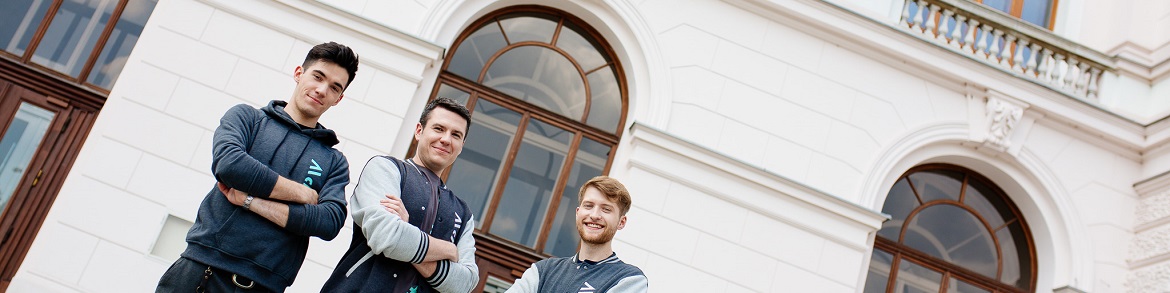
SKA team during the EVE CURiE launch
The EVE CURiE experiment, developed by members of the Student Astronautical Research Group (SKA), has successfully completed a stratospheric flight as part of the German-Swedish REXUS/BEXUS student programme. The project, which aims to investigate ways of increasing the electrical energy output of photovoltaic cells in space, reached an altitude of over 30 km during the BEXUS 36 Reflight campaign at the Esrange Space Center in Sweden.
The flight was originally scheduled to take place last year. At the time, the experiment was fully prepared and had successfully passed all the required tests. However, for reasons beyond the team's control, the launch did not take place. This year's campaign gave the students an opportunity to return to Esrange.
Before the launch, the team carried out final work on the experiment's electronics and mechanical structure and verified its compatibility with the balloon gondola. They also successfully tested communication between the experiment and the ground station, enabling real-time monitoring of data from radiation sensors and solar panels during the flight.
"Although the experiment itself had been prepared with great care, the campaign was not without its challenges," recalls Bartosz Peterson, member of the project team. "Diagnosing one of the electronic systems proved particularly demanding, as its failure only became apparent at a very late stage. Identifying the cause of the problem, confirming the damage and replacing the component took until late at night. Ultimately, after many hours of testing, EVE CURiE was ready for integration with the gondola and its flight."

The EVE CURiE experiment followed an earlier project called CURiE
Science and experience on a European space industry scale
The project was carried out as part of the REXUS/BEXUS programme, organised by the German Aerospace Center (DLR) and the Swedish National Space Agency (SNSA). Through cooperation with the European Space Agency (ESA), students from other countries also participate in the programme. Participants not only design and build their own experiments but also go through successive project development stages in accordance with the standards used in the European space industry. The programme includes training sessions, project reviews and consultations with experts.
As the team members point out, one of the greatest challenges was bringing together multiple engineering disciplines within a single project and adapting the design to the demanding conditions of the stratosphere. At altitudes of several dozen kilometres, the low air density makes electronic components particularly susceptible to overheating. This requires careful circuit design, material and thermal management solutions selection.
Participation in the programme has enabled the students to gain experience extending far beyond technical expertise. Working on project documentation, taking part in regular design reviews and delivering presentations in English to an international panel of experts have helped them develop their communication, organisational and project management skills. They have also gained insight into the entire life cycle of a space project – from defining a research objective and conducting analyses to design, testing and the launch campaign.
Data analysis and conference achievements
The team is currently conducting a detailed analysis of the data collected during the flight. Preliminary results indicate a relationship between flight altitude and the level of electrical energy generated. However, further research is needed to assess the practical applicability of this solution.
The project's findings are already being presented internationally. Thanks to funding from the Ministry of Science and Higher Education's programme, Supporting Students in Developing Their Competences and Skills, team members have presented their research at scientific conferences in Kraków and Hong Kong, where they received an award. Another presentation is planned in Xi'an, China.

The experiment was launched with a balloon grom the Swedish Esrange Space Center
Project Team
EVE CURiE is an interdisciplinary project carried out by 11 students from the Warsaw University of Technology, representing three faculties: Faculty of Power and Aeronautical Engineering, Faculty of Electronics and Information Technology, and Faculty of Physics. The project is led by Marek Pąśko from the Faculty of Power and Aeronautical Engineering.
Bringing together students from different academic disciplines made it possible to combine expertise in aerospace structures, electronics, measurement systems and radiation physics – a combination that was essential to the success of the project.
© 1998-2026 Warsaw University of Technology
Pl. Politechniki 1, 00-661 Warsaw, Poland