
European Rover Challenge 2026
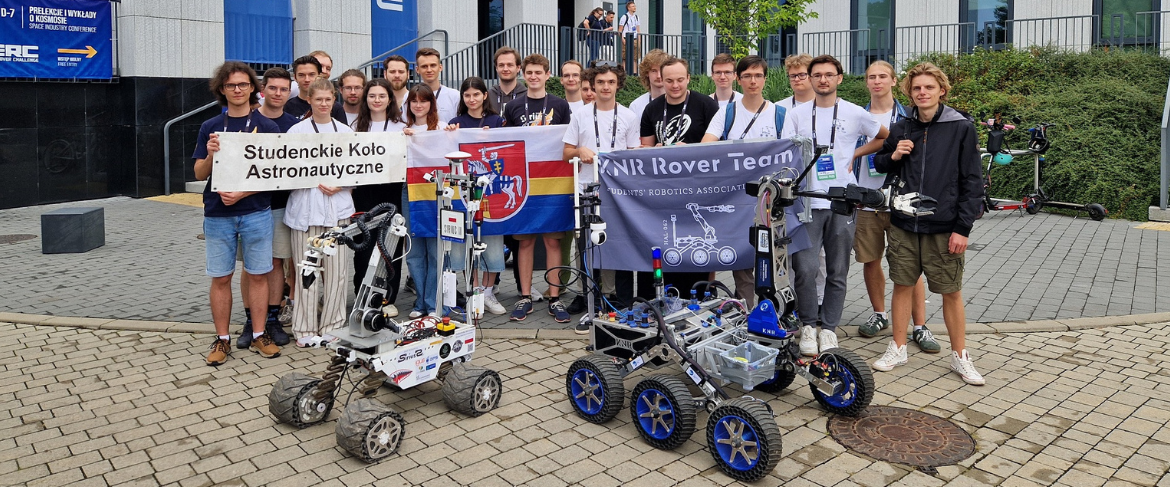
SKA Robotics and KNR Rover Team at the European Rover Challenge 2025
Two WUT teams in the final
From 4 to 6 September, Kraków will become the world capital of robotics. The city will host the next edition of the prestigious European Rover Challenge, with two teams from the Warsaw University of Technology taking part: KNR Rover Team and SKA Robotics. The 25 teams competing in the finals were selected from 124 entrants representing 29 countries around the world.
Teams of students from leading technical universities around the world enter the ERC. For many months, their members work on their own vehicles—from developing the concept and designing the rover to preparing the finished machine for the competition. Their work is then assessed by experts from the space industry and organisations active in the sector. The best teams meet on a specially prepared Martian course known as the Marsyard, where their rovers’ capabilities are tested in several tasks inspired by real space missions conducted by NASA, ESA and others. The ERC tasks mirror the challenges faced by rovers currently operating on Mars and the Moon. For the young engineers, the competition is an opportunity to put their knowledge into practice and showcase their ingenuity and engineering expertise to the public and seasoned representatives of the global space sector.
SKA Robotics
At this year’s competition, the SKA Robotics team plans above all to test several new and improved solutions. One of the most important will be the new Science module, including a drilling mechanism developed by the team to collect subsurface samples. The other technologies used in the rover are also being continuously refined. Drawing on experience from previous competitions and tests, the team analyses what worked well and where problems arose, and uses those findings to make further improvements.
“During the European Rover Challenge 2026, we will take on several tasks. In the Science Task, the rover will explore and analyse the terrain and collect samples both from the surface and from deeper layers of soil. This is where our new drilling module will be particularly important. The Navigation Task will test the rover’s ability to travel between designated points, as well as its autonomous systems. This task also includes the use of a drone,” explains Marta Dembińska, coordinator of the Robotics Section of the Student Astronautics Club. “In the Maintenance Task, the rover will use its manipulator to operate components on a dedicated panel, including switches, take measurements and insert an RJ-45 plug into the correct socket. The Probing Task, meanwhile, involves locating probes placed around the Marsyard, picking them up with the manipulator and placing them in a container on the rover. We will also face the Presentation Task, during which we will present our team, the rover’s design, the solutions we have used and its development process to the jury.”
Preparations for the competition were carried out in parallel by the different parts of the team. The software section focused primarily on developing and testing the software, control systems and autonomous solutions. The mechanical section, meanwhile, worked on the rover’s structure, manipulator and new modules, as well as on improving the reliability of the vehicle as a whole. Integrating these elements and testing them together was then a crucial stage, because only at that point was it possible to verify how all the systems worked together under conditions resembling those of the competition as closely as possible.
“We are not singling out any one task as the one in which we have the highest hopes. Each of them gives us an opportunity to test new solutions and collect data that will allow us to continue developing the rover. Of course, we want to achieve the best possible result, but validating the design and software in practice is just as important to us,” emphasises Marta Dembińska. “Our main goal at this year’s ERC is first and foremost to gain experience as a team. We have many new members this year, including people serving as coordinators for the first time, so the competition will be a very important test for us – not only technologically, but also organisationally. We want to learn as much as possible, see how we perform under time pressure, improve coordination between the sections and gather experience that we can use in future iterations of the rover and at subsequent competitions. A strong result would, of course, be enormously satisfying, but our main priority is the continued development of the team and our technologies.”
KNR Rover Team
The Robotics Student Research Group’s team is hoping at least to repeat its success from last year’s competition. The team also recently delivered an excellent performance at a similar event held in the United States.
“We are entering the ERC four months after finishing ninth at the University Rover Challenge in the United States - the competition that, one might say, inspired its European counterpart. It was a great result and makes us hope for an even better performance on home ground, although we know that Polish rovers are built to an exceptionally high standard,” says Mikołaj Stasiak of KNR Rover Team. “Last year, we won the award for the best performance in the Probing Task, collecting sample containers modelled on NASA’s Mars Sample Return mission in record time. We hope to repeat that success.”
KNR Rover Team has made an excellent start to this year’s ERC: the rover documentation submitted during the qualification stage was ranked sixth among all the teams in the competition.
“Since returning from the United States, we have focused on refining solutions specifically for the European Rover Challenge. We have also developed new low-level software for our manipulator at breakneck speed to improve its performance during the tasks,” adds Mikołaj Stasiak. “Even before the URC, we began working with our Student Research Group’s drone section, which prepared a drone for its dedicated autonomous-flight task. This is an excellent example of the interdisciplinary nature of our group and cooperation between its sections. The task itself is also interesting: once again, it is modelled on the mission of the Ingenuity drone on Mars. It is also being conducted in cooperation with MathWorks, the developer of MATLAB, which will be used during the task.”
This year’s ERC attracted 124 teams from 29 countries. Twenty-five teams, including five from Poland, advanced to the finals. The event will be held from 4 to 6 September 2026 on the campus of AGH University of Krakow at 19 Władysława Reymonta Street in Kraków. The Mars rover competition will run from Friday until Sunday lunchtime. Admission to all parts of the event is free.
More information is available on the organiser’s website.
© 1998-2026 Warsaw University of Technology
Pl. Politechniki 1, 00-661 Warsaw, Poland