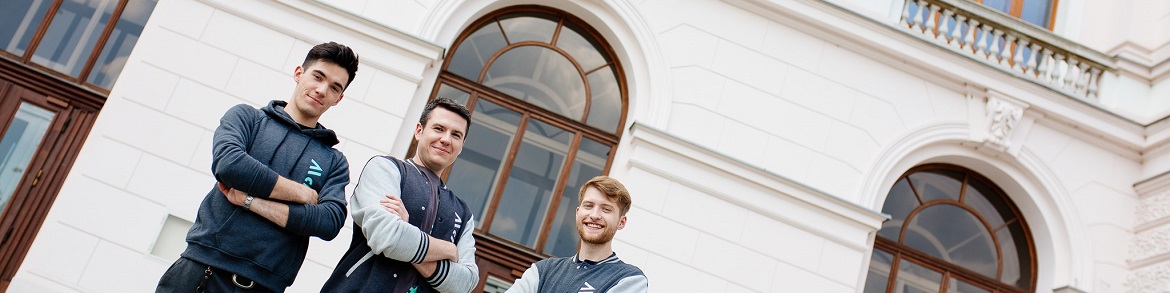
SAE AeroDesign’s impressions after the Air Cargo Challenge in Stuttgart

SAE AeroDesign Student Research Group at the Air Cargo Challenge in Stuttgart
Students from the SAE AeroDesign Student Research Group took part in the Air Cargo Challenge, an international aeronautical engineering competition held this time in Stuttgart. Their task was to build an aircraft capable of carrying the heaviest possible payload within a specified time. Our team achieved the best result in the group's history at this competition and returned richer in valuable experience.
During this year's edition, the Air Cargo Challenge involved designing and building an aircraft capable of transporting 330 ml cans as efficiently as possible. Scoring in the competition was based on technical documentation, design quality, the shortest take-off roll, the number of cans carried, and the distance covered in a given time. Additionally, beyond the scored metrics, the winglets developed by our team and the original livery received special recognition.
"We created our aircraft design from scratch, built a prototype, tested it in wind tunnels, and finally built the competition model. Our machine had a 4-meter wingspan and was capable of carrying up to 17 cans weighing 5.25 kg at a maximum take-off weight (MTOW) of 9.32 kg and a speed of over 90 km/h," says Olaf Adewoye from the Faculty of Power and Aeronautical Engineering, a member of SAE AeroDesign.

SAE AeroDesign Student Research Group at the Air Cargo Challenge in Stuttgart
Our students placed 15th out of 37 teams, representing a jump of about 20 places from previous years and marking SAE AeroDesign's best result in the history of its participation in this event. This year's performance was not without its challenges, which the team had to address on the fly.
"The biggest challenge during the construction and design of the aircraft was our group's limited resources—work was being carried out simultaneously on a total of 4 aircraft for different competitions, leaving us short on time and resources," explains Jakub Paź, Air Cargo class coordinator. "During the competition, the weather proved to be our biggest enemy. The intense heat and cloudless skies showed no mercy to our composite structure, which gradually weakened. As a team, within just 2 hours, we were able to repair a severely damaged wing and carry more mass in the next static test than during the ill-fated previous attempt."
As Jakub Paź points out, he really enjoyed the team's cohesion and the chance to gain new experiences and skills. Our students were able to assess damage and effectively repair it in a very short window between flights. Another positive was the opportunity to work with composites, which play an increasingly important role in today's world.

SAE AeroDesign Student Research Group at the Air Cargo Challenge in Stuttgart
What lies ahead?
The next edition of the Air Cargo Challenge will take place in 2 years, but our team isn't stopping!
"We will start our preparations by selecting new Air Cargo coordinators. Then, we will perform a detailed analysis of our previous design: what went wrong, what can be improved, and which areas to focus on. Next, we will create a preliminary design and prototype, test it in the wind tunnel and in flight, and only then will we begin work on the final aircraft," announces our student. "We are very pleased with this year's competition. We met many people and exchanged plenty of ideas with international students. We have drawn several conclusions and are confident that the next competition will go even better. We gained valuable experience and significantly improved the build quality of our aircraft. We hope to maintain our momentum in future competitions and finish among the top contenders."
© 1998-2026 Warsaw University of Technology
Pl. Politechniki 1, 00-661 Warsaw, Poland