
The HERCULES project
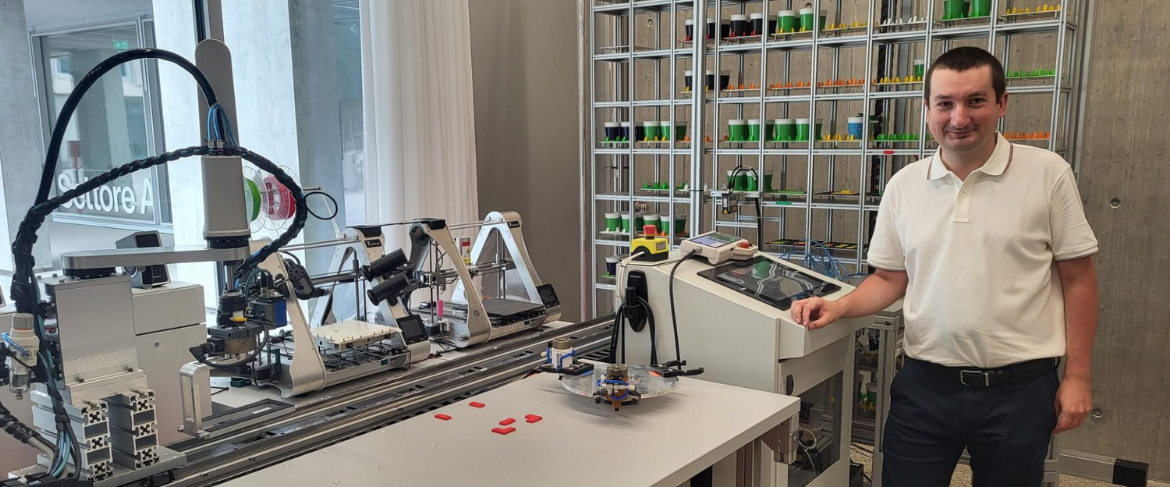
Krzysztof Ejsmont, PhD, at the SUPSI Laboratory
Warsaw University of Technology leads the consortium
The Warsaw University of Technology has received EUR 1.5 million for the implementation of the HERCULES project under the Horizon Europe programme. Its main objective is to strengthen the scientific potential and international position of the Warsaw University of Technology by establishing at WUT a competence centre in the field of human-centric automation – the Human-Centric Collaborative Automation Excellence Hub. The project leader is Krzysztof Ejsmont, PhD, from the Faculty of Mechanical and Industrial Engineering at WUT.
HERCULES (Human-cEntRic Collaborative aUtomation exceLlence hub for European widening countrieS) is a three-year project implemented under the Horizon Europe programme, within the Twinning instrument. The research area around which the potential is being built is Human-Robot Collaboration (HRC) in modern production systems. This is not only about developing technologies, but above all about designing automation in such a way that humans remain a central element of the system. A robot should not only perform its tasks safely, but also increasingly recognise human behaviour and intentions, adapt the way it cooperates to the operator, and take into account aspects such as cognitive workload, ergonomics, trust and the sense of safety. However, HERCULES has a much broader dimension than robotics alone.
"We want to use this research area as a starting point for a lasting increase in the Warsaw University of Technology’s capacity to conduct research at an international level. The project therefore encompasses, in parallel, the development of scientific competences, the internationalisation of research, researcher mobility, the preparation of joint publications and subsequent project proposals, cooperation with industry, and the professionalisation of research management," says the project leader, Krzysztof Ejsmont, PhD, from the Faculty of Mechanical and Industrial Engineering at WUT.
The effects of HERCULES
The most visible result of the project will be the establishment at the Warsaw University of Technology of a small but modern demonstration environment dedicated to Human-Robot Collaboration, without building a large-scale industrial infrastructure. The aim is to create a flexible research and demonstration environment that can be used for scientific experiments, educating students and PhD students, presenting new technologies and carrying out joint activities with enterprises. HERCULES is intended to ensure that a lasting ecosystem connecting research, education, international cooperation, industry and professional management of research activities is created at WUT around modern human-technology collaboration.
"In practice, we are transferring to WUT the experience of two very strong European partners: SUPSI from Switzerland and Politecnico di Milano from Italy. However, this is not about simply copying their solutions. We want to jointly develop a model adapted to the conditions of the Warsaw University of Technology, implement it, test its effectiveness, and then create a solution that can be further developed at WUT and potentially replicated in other institutions and universities as well," emphasises Krzysztof Ejsmont, PhD.
The demonstrator is intended to be the seed of a broader Human-Centric Collaborative Automation Hub, a place where research, teaching and industrial practice meet. It will be possible, among other things, to study human behaviour during cooperation with automated systems, design solutions using collaborative robots and wearable technologies, analyse data concerning the operator’s movement, behaviour and workload, and develop methods for more natural and safer human-machine cooperation. The second group of results consists of specific scientific outcomes. At least 12 joint peer-reviewed publications are planned, as well as the participation of WUT researchers in major scientific events, joint experiments and datasets, the development of research methods, and at least six jointly prepared proposals for Horizon Europe or other international research programmes.
It is important that HERCULES is not intended to end the cooperation, but to create a foundation for subsequent projects. The development of human capital will also be a result. The project provides for the exchange of researchers between Warsaw, Milan and Lugano, joint research, expert visits, mentoring, co-supervision of doctoral theses and supervision of master’s theses. We have also planned an international summer school at WUT and the inclusion of project results in academic courses. A less visible from the outside, but also very important, outcome will be the development and implementation of a professional research management model. The aim is to improve processes related, among other things, to the preparation of international projects, their implementation, research data management, Open Science, cooperation with enterprises and the use of research results.

Krzysztof Ejsmont, PhD, at the laboratory at Politecnico di Milano
Ultimately, a Collaborative Growth Framework will also be created – a kind of “roadmap” that can be used by other institutions, showing how to systematically build the international position of a research institution through cooperation with strong foreign partners.
"It is very important to me that after three years there will be more left from the project than just a set of reports. Success for me will be a situation in which the infrastructure continues to be used, teams continue to publish and prepare projects together, students use the environment that has been created, and the organisational solutions developed become part of the university’s everyday operations," says Krzysztof Ejsmont, PhD.
The project addresses several interrelated challenges
Modern automation is developing very rapidly, but simply increasing the autonomy of machines is not enough. If humans and robots are to truly cooperate, the system should take into account human capabilities, limitations and behaviour. Therefore, the project participants are interested, among other things, in recognising operator intentions, human-robot communication, ergonomics, safety, trust in automated systems and cognitive workload. This represents a shift from the approach of “how to automate human work” to the question of “how to design technology so that humans and machines can cooperate effectively”. Another challenge concerns the transfer of knowledge to enterprises. Many new technologies are developed in laboratories, but the path from a scientific publication to actual industrial application can be long. Therefore, the aim is to create an environment in which enterprises can learn about solutions, participate in pilot projects, propose research problems, and cooperate with students and researchers. The internationalisation of research activities is another challenge.
"We want to increase the presence of WUT researchers in European scientific networks, the number of publications resulting from international cooperation, and effectiveness in creating consortia and obtaining funding from European research programmes. Another challenge is related to organisation. Excellent research requires not only good researchers, but also a good organisational environment. Therefore, HERCULES includes the analysis and development of processes supporting the preparation and implementation of projects, data management, Open Science, cooperation with the external environment and the development of international partnerships. It is precisely the combination of these four perspectives that I find particularly interesting: technology, people, organisation and international cooperation must develop in parallel," explains the HERCULES project leader.
Beneficiaries of the project results
Thanks to the HERCULES project, researchers will gain access to a new experimental environment, research methods and a cooperation network with SUPSI, Politecnico di Milano and other European partners. This should facilitate conducting research at a higher level and creating stronger project consortia. Students and PhD students will be able to use the demonstrator during classes, carry out diploma and doctoral theses, participate in experiments, summer schools and international mobility programmes. It is particularly important for Krzysztof Ejsmont, PhD, that contact with modern robotics, automation and Industry 5.0 technologies should not be limited to presentations or simulations, but should include actual experimental work. The HERCULES project will also benefit entities outside the academic world. Manufacturing companies will be able to use the Hub as a space for contact with academia.
"We want to involve companies in workshops, pilot projects, technical visits, diploma theses carried out jointly with industry and subsequent research and development projects. The project assumes the involvement of at least 15 industrial stakeholders and the conclusion of new formal cooperation agreements," notes Krzysztof Ejsmont. "Research support staff, in turn, will benefit from the transfer of good practices concerning the preparation and management of European projects, Open Science, data management, cooperation with stakeholders and other elements of professional research management. In the longer term, the regional innovation ecosystem should also be a beneficiary. We want WUT to play a stronger role as a link between Polish enterprises and institutions and European research and innovation networks."
WUT researchers involved in the international project
The Warsaw University of Technology team is interdisciplinary and combines competences related to production management and engineering, automation and robotics, ergonomics, sustainable development and research management.
The project leader is Krzysztof Ejsmont, PhD, a research and teaching assistant professor at the Faculty of Mechanical and Industrial Engineering of the Warsaw University of Technology and Acting Head of the Production Processes and Logistics Division. In the HERCULES project, he is responsible for the scientific and organisational coordination of the project, the development of the Human-Centric Co-Hub, conducting joint research, cooperation with foreign and industrial partners, the development of the international network and the preparation of proposals for subsequent research projects. His scientific activity focuses on operational management, digital transformation and the application of Industry 4.0 and 5.0 technologies in modern production systems. He conducts research on Human-Robot Collaboration, artificial intelligence, digital twins, cyber-physical systems and decision-support methods in the production environment. Particular attention is paid to the design of human-oriented technological solutions integrating technical, organisational and social aspects in line with the principles of Industry 5.0. He has many years of experience in implementing international research and development projects funded by the EU, including Horizon 2020, Horizon Europe and Erasmus+, serving as a task and work package leader.

Krzysztof Ejsmont, PhD, at the SUPSI campus
Researchers from the Faculty of Mechanical and Industrial Engineering at WUT are involved in the project. Bartłomiej Gładysz, PhD, participates in activities related to Industry 5.0, Operator 5.0, human-centric manufacturing, the development of the Hubo scientific concept and the transfer of research results to scientific and teaching activities. Jacek Kozłowski, PhD, contributes technical competences related to automation, robotics and production systems, particularly relevant during the design and launch of the demonstration environment and the conduct of experiments. Aneta Kossobudzka-Górska, PhD, participates in activities related to the human factor, ergonomics and the assessment of human-technology interaction, which constitute one of the key elements of human-centric automation. Professor Aldona Kluczek supports the team with her experience in sustainable development, technology and production systems management, and strengthens the scientific and strategic dimension of the research being carried out. Aleksander Buczacki, PhD, participates in activities related to innovation management, cooperation with the external environment and the development of the science-industry cooperation ecosystem, while Izabela Maleńczyk, PhD, strengthens activities related to research management, communication and dissemination of project results, as well as the development of competences and organisational solutions supporting the functioning of the Hub being established. The project also provides for the involvement of additional staff, young researchers, PhD students and WUT students in research, mobility, training and activities carried out with partners.
The HERCULES project consortium consists of three universities: Warsaw University of Technology, which is the project coordinator, SUPSI – University of Applied Sciences and Arts of Southern Switzerland from Switzerland, and POLIMI – Politecnico di Milano from Italy. The selection of partners is not accidental – both universities cooperating with WUT have experience in Human-Robot Collaboration, Industry 4.0/5.0, cooperation with industry and the implementation of large European projects. SUPSI has, among other things, a developed Mini-Factory-type environment and extensive experience in conducting research on adaptive Human-Robot Collaboration. Politecnico di Milano contributes, among other things, competences in human-centric manufacturing design, human factors, research management and an extensive European cooperation network.
"It is also very important that we are not starting cooperation as three institutions that do not know each other. WUT has been cooperating with both SUPSI and Politecnico di Milano for many years. We have jointly implemented European and educational projects, publications, staff and student mobility programmes, study visits and joint teaching initiatives. HERCULES is therefore another, but much more strategic, stage of this cooperation," emphasises Krzysztof Ejsmont.
However, the cooperation to date has focused primarily on the implementation of specific research, projects or educational activities. HERCULES goes one step further. We want to use the trust and experience built over the years to create a lasting structure for cooperation and the transfer of excellence that will remain at WUT. The project has been planned for 36 months and, importantly, many of its results have been deliberately designed to continue functioning after the end of funding. This applies primarily to the Co-Hub, the partner network, the research management model and the joint research agenda.
What opportunities and possibilities does the HERCULES project open up?
The project has not been designed to conduct a specific set of research activities for three years and then end the activities when the funding ends. First, a permanent research environment related to Human-Robot Collaboration and Industry 5.0 will be established, which can be further developed and used in subsequent projects, research and teaching. Second, the project gives WUT access to the knowledge, experience and network of contacts of two very strong European partners. SUPSI and Politecnico di Milano have extensive experience in European projects, cooperation with industry and the creation of research and demonstration environments. The transfer of this experience may increase WUT’s effectiveness in subsequent European calls. Moreover, the project team aims to increase the internationalisation of research and assumes an increase in the number of publications with foreign partners, new European projects, mobility opportunities, jointly conducted research and doctoral work, as well as the presence of our researchers in international networks.
HERCULES is also intended to leave organisational competences at WUT. This concerns professional management of research projects, proposal preparation, Open Science, data management, building partnerships and cooperation with industry. Finally, the project may strengthen integration within the university itself. One of its objectives is the transfer of good practices between WUT teams and units.
"We want to test in practice a model in which teams that already have extensive international experience help other research groups to enter European research networks more strongly. Therefore, the greatest value of HERCULES may not be a single technology, but the ability to generate subsequent projects, publications, partnerships and initiatives long after the project itself has ended," explains Krzysztof Ejsmont, project leader.
The project has a very clear development logic. A four-phase model called the Excellence Hub Transfer Cycle has been adopted.
- The first stage – diagnosis and design. First, we analyse the starting point in detail: existing competences, infrastructure, research management processes, cooperation networks and WUT’s needs. On this basis, together with the partners, we design the target Hub model and its development path.
- The second stage – transfer and experimentation. This is followed by intensive knowledge transfer through training, mobility, expert visits, job shadowing and joint experiments. We do not want to mechanically copy the partners’ solutions, but to test them and adapt them to WUT’s realities.
- The third stage – implementation and institutionalisation. Solutions that prove successful will be incorporated into WUT’s activities. This applies both to the research environment and to new research methods, project management and cooperation with partners.
- The fourth stage – dissemination and sustainability. In the final stage, we want to ensure the sustainability of the results, develop new projects, expand the partner network and prepare a model that can also be applied in other units.
Operationally, the project has been divided into eight work packages covering research on HRC, the development of research management, the creation of a cooperation ecosystem, communication and exploitation of results, and overall project management.
"Paradoxically, the most difficult part is not purchasing the equipment itself or conducting a single experiment. The greatest amount of work is required to combine very different elements into one sustainable system," emphasises Krzysztof Ejsmont. "From a scientific point of view, preparing experiments involving people will be particularly demanding. Human-Robot Collaboration research must meet high methodological, ethical and data protection standards. We will analyse, among other things, movement and behavioural data, and potentially also physiological data, which is why issues such as informed consent of participants, data anonymisation, safety and compliance with GDPR and FAIR principles are very important."
The second major challenge is to build the demonstrator in such a way that it is not a one-off installation prepared solely for the purposes of the project. It must be flexible and useful simultaneously for research, students and enterprises, and allow for further expansion. The sustainability of organisational change is also a challenge. It is relatively easy to conduct training or a study visit. It is much more difficult to ensure that the solutions learned are actually adopted, adapted to the conditions of the university and used several years later. Therefore, HERCULES places a great deal of emphasis on the institutionalisation of the results. The project brings together researchers, technical specialists, administration, students, PhD students, enterprises and three universities operating within different organisational systems – coordination is therefore also a challenge, so that all these activities lead to a common goal.
© 1998-2026 Warsaw University of Technology
Pl. Politechniki 1, 00-661 Warsaw, Poland