
Biodegradable implant for saving vision

Ophthalmology greatly benefits from the integration of medical and engineering skills, photo: Pixabay
Retinal detachment is one of the most serious ophthalmic emergencies and, without prompt intervention, leads to loss of vision. For more than half a century, the standard treatment has been scleral buckling – a surgical procedure in which a silicone band is placed around the eye to indent the wall at the site of the retinal tear. Although effective, the method is associated with numerous complications, ranging from myopia to infections and the need for additional surgeries to remove the implant.
A team led by Dr Sabina Wilkanowicz from the Warsaw University of Technology’s Płock Branch has proposed a breakthrough solution: a biodegradable implant produced using electrospinning and made of PLGA, a copolymer of lactic and glycolic acids. What is more, the implant not only provides mechanical support during the healing process but also gradually releases two drugs – the antibiotic moxifloxacin and the anti‑inflammatory dexamethasone.
“We wanted to create a material that would fulfil the role of a traditional implant while also degrading on its own and releasing the drugs conventionally used to treat this condition, thereby eliminating the risk of complications and additional surgeries,” emphasises Dr Sabina Wilkanowicz.
In the experiments, the researchers obtained implants with a uniform nanofiber structure capable of controlled drug release. During the first week of laboratory tests, approximately 20% of the active substances diffused into the surrounding environment – the amount needed in the initial phase of healing to prevent infection and postoperative inflammation.
The implant gradually biodegraded: depending on the polymer composition, complete degradation occurred after 15–20 weeks. The studies also showed that stretching the implant (to simulate the mechanical conditions in the eye) shortened the degradation time to around 14–16 weeks, which corresponds to the period required for tissue healing.
“Our research shows that it is possible to combine chemical and materials engineering with medicine in a way that enhances patient safety and treatment comfort,” says Dr Wilkanowicz.
The researchers plan further studies on modifying the implant’s structure and increasing the efficiency of drug release in the first days after surgery. Among the options being considered are layered core-shell implants, which could provide even better therapeutic performance.
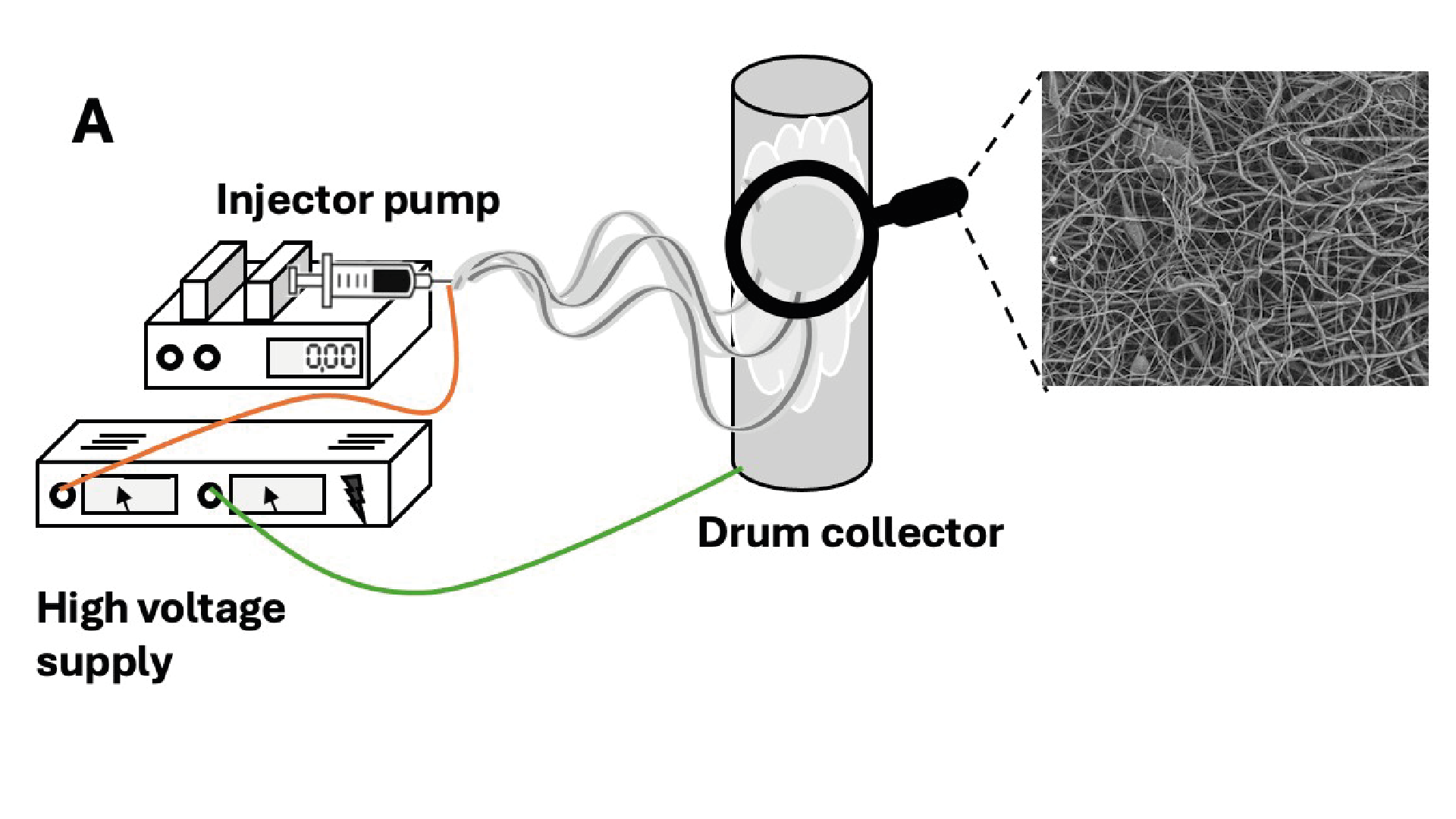
Diagram of the device used to produce the implant on an electrospinning machine built at WUT
The project was carried out with the support of the Michigan Institute for Clinical & Health Research, the National Science Centre (MINIATURA 5 programme) and the Warsaw University of Technology.
© 1998-2026 Warsaw University of Technology
Pl. Politechniki 1, 00-661 Warsaw, Poland