
Michał Łepek, PhD, wins the NATO STO award
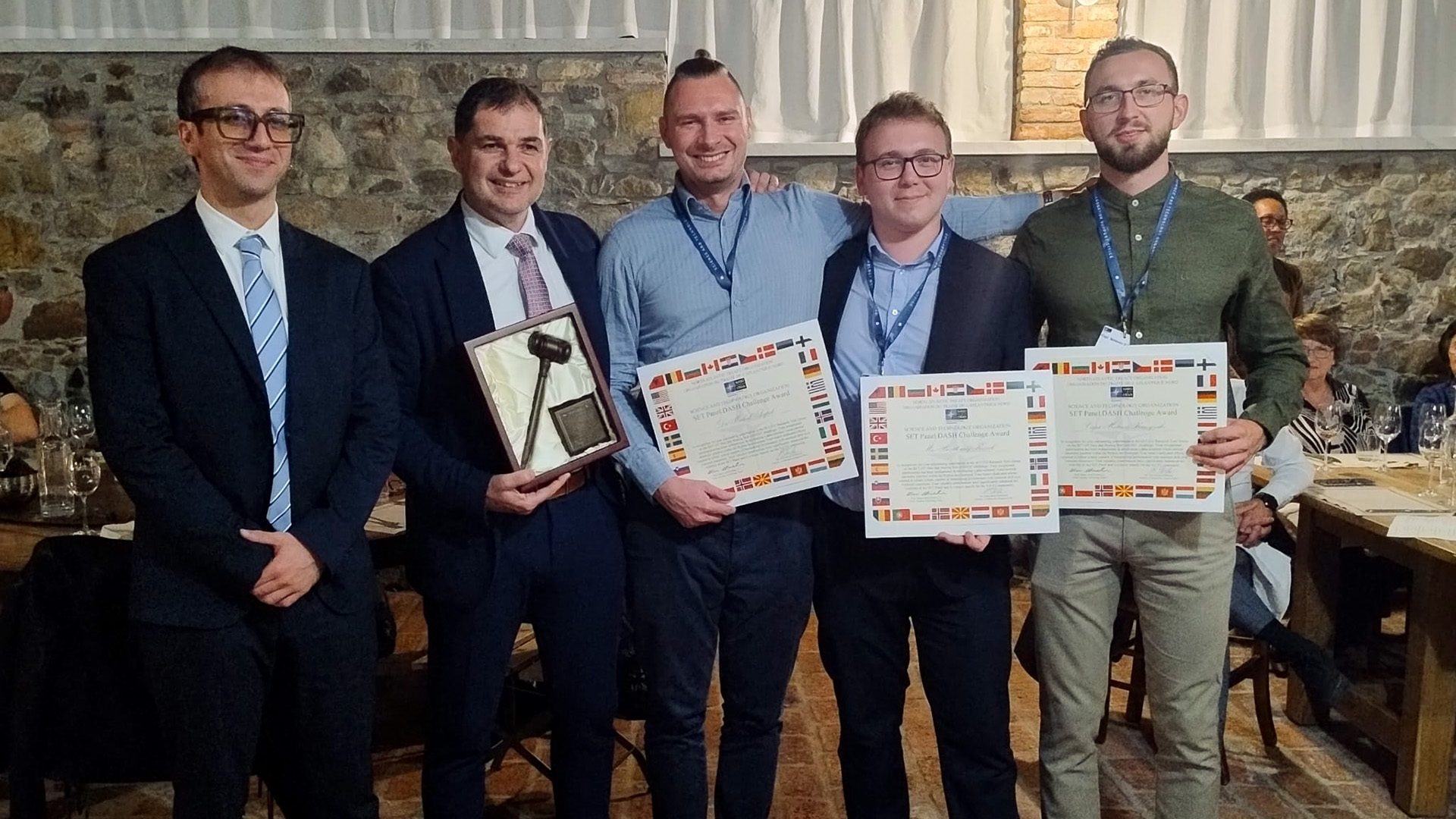
The winning team with diplomas. Michał Łepek, the WUT representative in the middle, to the right, the other competition team members – Bartłomiej Koszek and Mateusz Kaszyński
The algorithm developed by the team of representatives of the WUT Faculty of Physics, KU Leuven, and Military University of Technology (WAT) proved to be the best presented at the Data Challenge organised by the technological branch of NATO.
The participants’ challenge was related to GNSS (Global Navigation Satellite System), whose most widely known example, used by most of us daily, is the most widespread GPS system (Global Positioning System).
The extreme usefulness of satellite systems goes hand in hand with high susceptibility to interference, both natural and deliberately caused by humans. The teams participating in the programming competition had to create an algorithm utilising a gyroscope, accelerometer, and camera. It will track the position of a drone or aircraft in a hostile environment where GPS signals are interrupted, e.g., due to jamming by the enemy. This task addresses one of the crucial technological threats identified by NATO in areas affected by armed conflict.
“In 2024 I found out about Summer School on Sensing Technology organised in Helsinki and prepared by NATO STO,” recalls Michał Łepek, PhD, team leader, who works on a daily basis at the Division of Complex Systems Physics and focuses on the creation of algorithms and the study of modularity and fractality of complex networks such as the Internet, among other things. "My job at the Faculty might not be directly linked to defense issues, but my interests and prior professional experience made me eager to take part in the training,” adds Dr Łepek. “It was its participants who were invited to join the competition as part of the Data Challenge.”
Our physicist set up a team with Captain Mateusz Kaszyński, MSc (WAT), and Bartłomiej Koszek, MSc (KU Leuven / Star Forge Technologies). They jointly developed a data-oriented visual-inertial system for flight trajectory tracking in the Python environment.
“Our solution is based on five pillars: standard model for tracking the object position in 3D space, analysis of inertial data, analysis of visual data, use of digital terrain model, and rules of data merging prepared specifically for a data-oriented solution,” lists Dr Łepek. “The developed method is distinguished by its resistance to changes in terrain appearance, which is critical given the diversity of visual data from different seasons, and its ability to operate on a standard processor in real time, which cannot be overestimated when used in a real flying platform with limited computing capabilities.”
NATO Science and Technology Organisation is a structure in the North Atlantic Alliance conducting innovative research and analyses in the field of defence and security. Scientific knowledge, innovations, and technological solutions are to support the fundamental tasks of the Alliance.
© 1998-2026 Warsaw University of Technology
Pl. Politechniki 1, 00-661 Warsaw, Poland