
The next stage of WUT research at the site of Treblinka II

The former extermination camp in Treblinka – view of an archaeological excavation site where traces of an old road leading to the gas chambers have been recorded, photo credit: Sebastian Różycki
This year, WUT scientists have continued the non-invasive research programme conducted by the Warsaw University of Technology at the site of the former Treblinka II extermination camp. This year’s work aimed to carry out a detailed survey of the internal roads of the camp, with particular emphasis on the route leading to the gas chambers.
“We have used a set of complementary measurement methods: photogrammetry with the use of drones (UAVs), RTK GPS surveying, terrestrial laser scanning, and geophysical methods: ground-penetrating radar (GPR), magnetometry, and conductometry. The combination of these data allowed for the introductory mapping of relics of former transport structures and their analysis in comparison with earlier topographical interpretations,” says Sebastian Różycki, PhD, from the WUT Faculty of Geodesy and Cartography.
This year’s field season ended in mid-September, and at the moment, a detailed analysis and correlation of the obtained results with the data from previous research campaigns is underway. Everything indicates that it will be possible to reconstruct almost the entire route leading to the gas chambers, which is one of the key objectives of the entire programme.
“This discovery is groundbreaking because, for the first time, it will be possible to fully combine a transport system with the layout of individual functional camp zones, simultaneously confirming the results of previous archival analyses. The results obtained are a crucial stage in the process of reconstruction of the topography of the Treblinka II extermination camp. They allow for an increasingly fuller understanding of the spatial layout of the place and the dynamics of its destruction and transformations after 1943,” emphasises Dr Różycki. “So far, around 70% of the camp’s area has been studied, including all main zones, from the railway ramp, through the roads and technical support areas, to the area where the gas chambers and the infirmary were located. The results provide solid foundations for further digital reconstruction and development of a coherent 3D model of the entire establishment.”
During the conducted research, the biggest challenge was the area near the main monument and part of the modern forest, where the course of the discovered road continues. Dr Różycki explains that the preservation of traces of the former transport route is extremely shallow beneath the surface of the ground, and some of the traces were destroyed during the construction of the monument between 1959 and 1960.
“We were discovering something of ‘dust remains after structures’, fragmented relics of facilities and roads, which were destroyed both during the liquidation process by the Germans in 1943 and during transformations of the area later. Due to the degree of destruction and character of the material, currently available measuring techniques do not allow for obtaining unambiguous results, which requires extremely careful interpretation and combining data from multiple sources.”
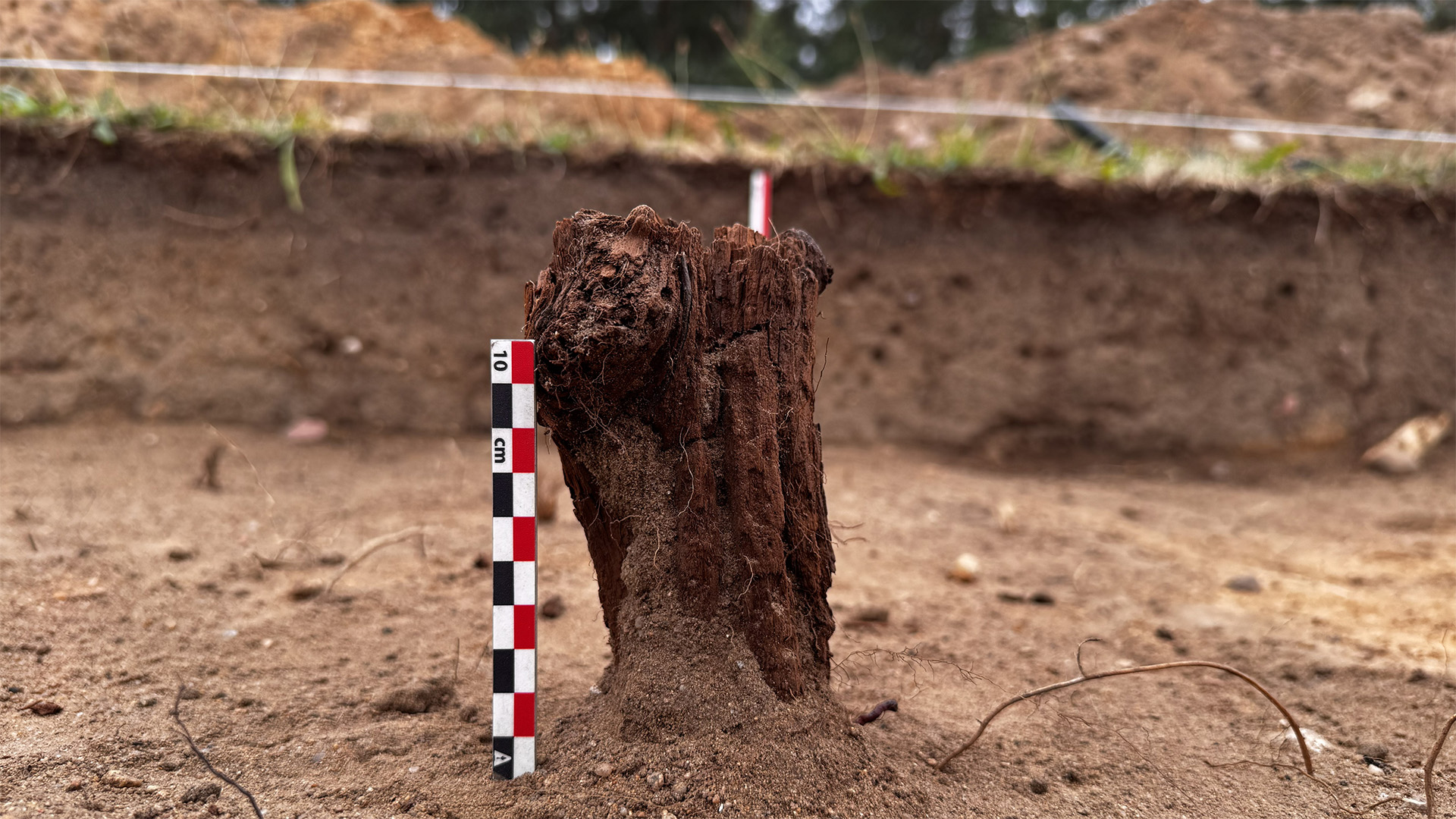
Former extermination camp in Treblinka – remains of a fence pole uncovered during archaeological work, photo credit: Sebastian Różycki
Participants of the research included the employees and doctoral students of the Faculty of Geodesy and Cartography of the Warsaw University of Technology, as well as the collaborators from other scientific centres. Dr Różycki’s team included, among others, Michał Pisz, PhD, from the University of Bradford, responsible for magneto-metric measurements and GPR, Szymon Lenarczyk, PhD, an archaeologist, and Szymon Oryński, MSc, from the Institute of Geophysics of the Polish Academy of Sciences, responsible for conductometric measurements.
The entire project is implemented in collaboration with the Treblinka Museum, which actively participates in the process of documentation and interpretation of results. Research was conducted under the supervision of the Rabbinical Commission for Cemeteries, which ensured full respect for the religious character of the site and compliance with halachic principles applicable to research in burial grounds.
Further research plans
In the next stages, work is planned in the north-western part of the camp, the so-called reception zone, where scientists expect to find relics of technical facilities and auxiliary infrastructure. There are parallel efforts to prepare the full topography of the camp and 3D visualisation, which will become part of the new exhibition concept and spatial narrative of the emerging Treblinka Museum, prepared by the Jewish Historical Institute (ZIH).
The results of this year’s research have a direct impact on the future commemoration of the place, and the entire project is financed by the Ministry of Culture and National Heritage as part of the programme for research and documentation of extermination sites. What is important, as part of work conducted in 2025, our scientists are also preparing innovative forms of presenting research findings, including 3D printed models of artefacts and descriptions in Braille alphabet, dedicated to blind and visually impaired people.
“This is the first initiative of its kind in Poland in the context of research on extermination sites, aimed at enabling all visitors, including those with sensory disabilities, to come into direct contact with the material and symbolic heritage of Treblinka. This approach is an important step towards including groups that have previously been excluded from the experience of historical exhibitions, especially with regard to non-invasive research, whose results have been difficult to convey in a tangible form until now,” emphasises Sebastian Różycki, PhD.
© 1998-2026 Warsaw University of Technology
Pl. Politechniki 1, 00-661 Warsaw, Poland