WUT students conquer the USA
Our students at StarkHacks in the USA
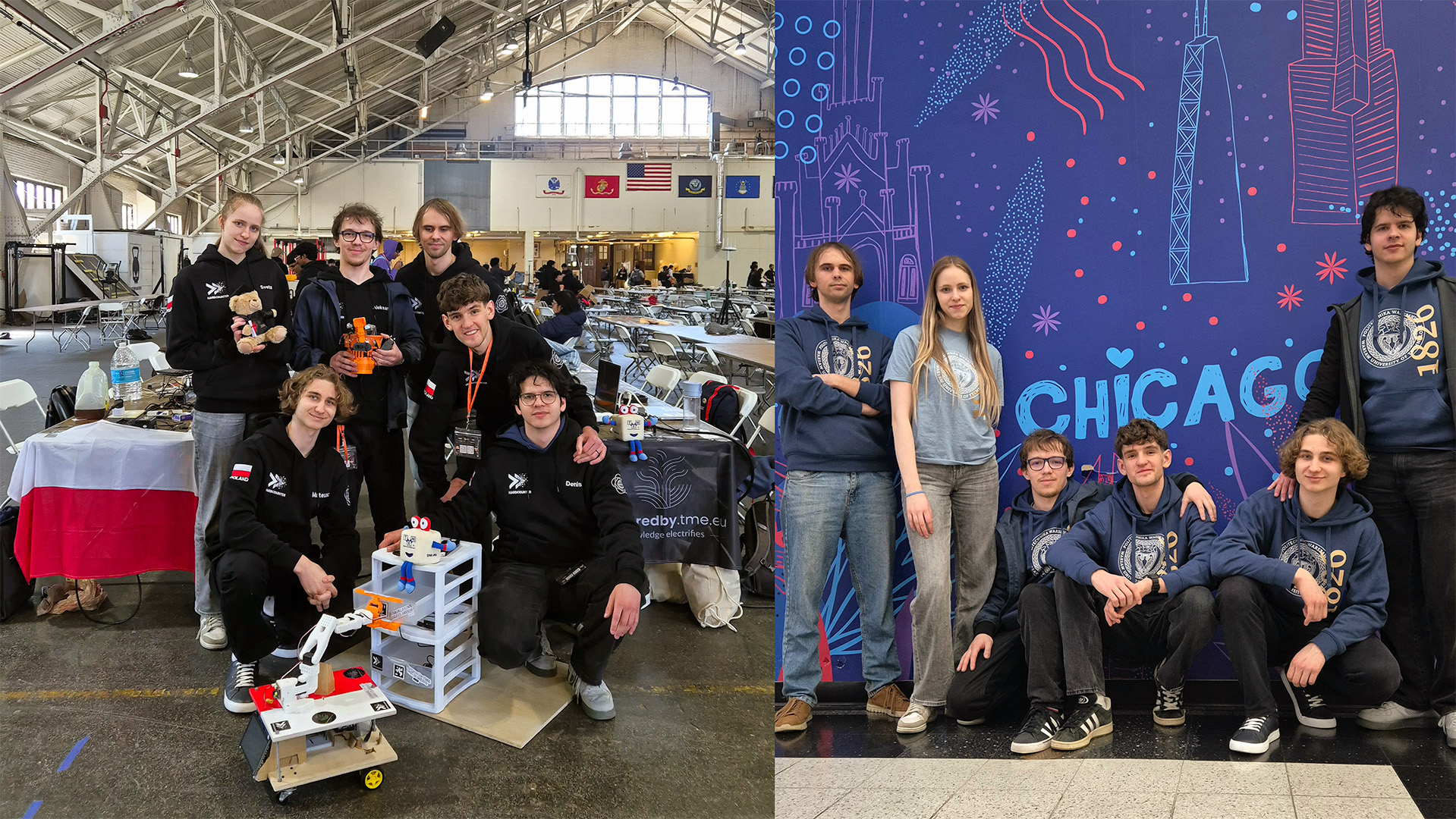
Students from the Faculty of Mathematics and Information Science of WUT made a strong impact at this year’s edition of the global StarkHacks hackathon in the US. The HardCounter team consisted of Piotr Czechowski, Svetlana Gridina, Mateusz Błażejowski and Denis Lisovytskiy, while the CompMech team was formed by Aleksander Jeżowski and Rafał Lasota. HardCounter won 1st place in the main Microsoft track, AI & Automation, and 2nd place in the Best Use of Viam category for the project “RackMedic” (DataCenter Automata). CompMech took 2nd place in the Ford track with their project “Zero Depth”.
“It was a phenomenal experience. StarkHacks at Purdue University is the largest hardware hackathon in the world, and the scale of the event made a huge impression on us. In the vast, historic Purdue University Armory building, we competed among nearly 1,000 participants from more than 10 countries. We also had an amazing opportunity to meet many technology enthusiasts from around the globe and experience firsthand what the culture and student life at Purdue University are like,” says Piotr Czechowski from the HardCounter team.

Students at StarkHacks in the USA
“The atmosphere was incredible and full of engineering energy. The best part, however, was the opportunity for direct consultations. We had engineers from the world’s largest corporations, such as Viam, Microsoft, Ford and AMD, practically within arm’s reach. We could confront our architectural ideas with them and receive precise, professional feedback. Conversations with the judges, who work daily with similar machines, operating in demanding industrial environments, gave us invaluable perspective and motivation,” emphasises our student.

Our students at StarkHacks in the USA
The hardest challenges
“The biggest obstacles were the extreme exhaustion and pressure. During the 36‑hour engineering marathon we worked at full speed, almost completely giving up sleep. Since we were building physical robots that had to operate reliably, we faced numerous failures at four or five in the morning, including system overloads and communication drops between the software and sensors. We also encountered a critical issue in the control software for the robotic arm provided by Viam, where we discovered a bug in the original code. During the hackathon, the judges gave us special recognition for identifying this problem in the framework, but it meant we had to abandon their ready‑made arm rotation solutions and write our own control scripts overnight, relying on our own mathematics and code. To ensure spatial orientation of the rover, we additionally used AprilTags visual markers with our own detection implementation. Despite the platform failures, we managed to integrate all components into a working system within the required time,” adds Piotr Czechowski.

Our students at StarkHacks in the USA
Our students on the podium in several categories
Due to the complexity of the projects, our team split into two groups to work in parallel and with maximum focus on different technological tracks. Both solutions received high recognition from judges representing global technology corporations.
- The HardCounter team (Piotr Czechowski, Svetlana Gridina, Mateusz Błażejowski, Denis Lisovytskiy) won first place in the main Microsoft track, AI & Automation, and second place in the Best Use of Viam category for their project “RackMedic” (DataCenter Automata).
“Our project is a fully autonomous mobile manipulator, a rover equipped with a robotic arm, designed for unattended servicing of data centre server racks. We built a complete system: from distributed thermal nodes based on ESP32 units installed in the server room and which stream telemetry, to a decision‑making module powered by Google’s advanced multimodal LLM, Gemini. When the system detects a thermal anomaly, the rover moves with dispatcher‑level precision to the affected rack. There, using computer vision, including Viam models and ArUco fiducial markers, it positions itself precisely in front of the correct shelf. The built‑in robotic arm automatically reaches for the handle and removes the faulty server module from the rack to prevent overheating and network failures. The entire system is integrated with a clear control panel that allows for remote monitoring, issuing commands and managing the situation. It is a demanding, interdisciplinary architectural challenge that combines AI, electronics, mechanics and high‑availability backend,” explains Piotr Czechowski.
- The CompMech team (Aleksander Jeżowski, Rafał Lasota) took second place in the Ford track with their project “Zero Depth”.
The team developed an advanced intelligent industrial attachment designed to support operation in complex spatial environments. Using deep learning and precise sensor processing, the tool addresses a key challenge of depth perception for automated grippers, significantly increasing the safety and precision of Ford’s robotic arms in potentially demanding industrial conditions. Working under time pressure did not diminish the impressive technical quality of their prototype.

Our students at StarkHacks in the USA
“What we’re experiencing right now is enormous relief, pride and joy. When the results were announced and we received the awards from the jury representing companies such as Microsoft, all the stress disappeared instantly. We are very happy that the hard, almost continuous work paid off. As the only Polish team, we were highly recognisable at the event, and the opportunity to represent Poland and Warsaw University of Technology fills us with great pride. We proved that we are able to deliver working prototypes under immense time pressure,” emphasises Piotr Czechowski from the HardCounter team.
“This achievement would not have been possible without the support we received before the trip. The equipment provided by our Main Partner, TME, was crucial for ensuring the reliability of the prototypes we were building at night. Thanks to the involvement of PwC CTech, the logistics of travelling overseas went smoothly. We are also proud that at every stage we could count on the support of Warsaw University of Technology.”

Our students at StarkHacks in the USA
© 1998-2026 Warsaw University of Technology
Pl. Politechniki 1, 00-661 Warsaw, Poland